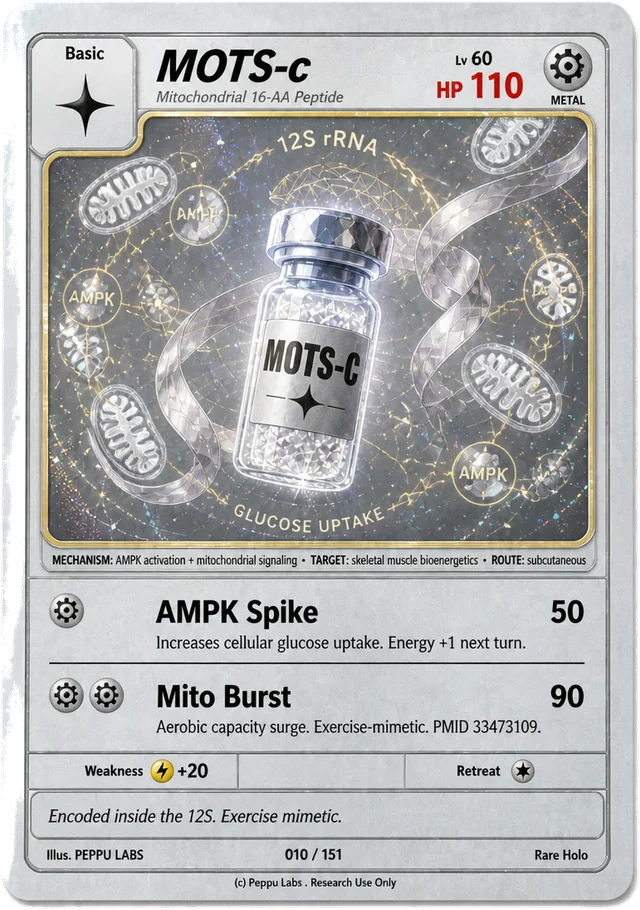
NO. 010 · BASIC · Lv. 60 · HP 110
MOTS-c
Mitochondrial 16-AA Peptide
ALIASES
MOTS-c, Mitochondrial ORF of 12S rRNA-c, MDP-16
CLASS
Mitochondrial-derived 16-amino-acid peptide (MDP)
FORMULA
C84H139N21O22S2
SEQUENCE
MRWQEMGYIFYPRKLR
HALF-LIFE
~30 min plasma (rodent), longer tissue residence
ROUTES
Subcutaneous (research) · Intraperitoneal (animal studies)
MECHANISM OF ACTION
16-amino-acid peptide encoded by a short open reading frame within the mitochondrial 12S rRNA. Activates the AMPK pathway in cell-culture and animal-model studies.
EVIDENCE GRADES
Lee, Cohen et al. 2015 (Cell Metab, PMID 25738459) · the discovery paper showed MOTS-c reversed insulin resistance in mice.
Reynolds JC et al. 2021 (Nat Commun, PMID 33473109) · MOTS-c improved treadmill performance and grip strength in aged mice.
Mechanism well-characterized. MOTS-c inhibits the folate cycle and de novo purine biosynthesis, activating AMPK.
Early-stage. Several small studies on insulin-resistance populations listed on ClinicalTrials.gov; no Phase 3 completions.
MECHANISM CATEGORIES
RESEARCH CONDITIONS
SAFETY
Side effects
- Limited human safety data
- Animal toxicology shows wide therapeutic window
Known interactions
- Anti-diabetic medications (theoretical, due to insulin-sensitivity effect)
Contraindications
- Active malignancy (theoretical)
- Pregnancy/lactation (unstudied)
REGULATORY STATUS
FDA · Not FDA-approved for any human use. Research-use only.
WADA · Not currently listed on the WADA Prohibited List (2026).
STORAGE
Lyophilized · 4 °C 24 months, −20 °C indefinite
Reconstituted · 2–8 °C, 28 days
PEER-REVIEWED EVIDENCE
- Lee C, Zeng J, Drew BG, et al.. The mitochondrial-derived peptide MOTS-c promotes metabolic homeostasis and reduces obesity and insulin resistance. Cell Metab 2015. PMID 25738459. link →
- Reynolds JC, Lai RW, Woodhead JST, et al.. MOTS-c is an exercise-induced mitochondrial-encoded regulator of age-dependent physical decline and muscle homeostasis. Nat Commun 2021. PMID 33473109. link →
- Kim KH, Son JM, Benayoun BA, Lee C. The Mitochondrial-Encoded Peptide MOTS-c Translocates to the Nucleus to Regulate Nuclear Gene Expression. Cell Metab 2018. PMID 29983246. link →
FAQ · 11 QUESTIONS
▶ What is MOTS-c?
MOTS-c is a 16-amino-acid peptide encoded by a short open reading frame (sORF) within the mitochondrial 12S rRNA region. It was discovered in 2015 by Pinchas Cohen's lab at USC and is one of a small but growing class of mitochondrial-derived peptides (MDPs).
▶ Why is MOTS-c unique among peptides?
Because it is encoded by the mitochondrial genome, not the nuclear genome. Almost every other peptide in human pharmacology is nuclear-encoded. This discovery overturned the assumption that mtDNA encodes only the 13 oxidative-phosphorylation subunits plus rRNAs and tRNAs.
▶ MOTS-c mechanism of action?
MOTS-c translocates to the cell nucleus under metabolic stress (glucose deprivation, oxidative stress, exercise), where it modulates nuclear gene expression in response to mitochondrial state. It activates AMPK, enhances glucose uptake in skeletal muscle independently of insulin, and improves insulin sensitivity in diet-induced obese rodent models.
▶ What does MOTS-c do for exercise?
MOTS-c is called an exercise-mimetic peptide because exercise is one of the natural triggers for its release from mitochondria. In aged mice, exogenous MOTS-c administration improves treadmill performance and grip strength (Reynolds et al. 2021, PMID 33473109).
▶ Is MOTS-c FDA-approved?
No. MOTS-c is not FDA-approved for any human indication. It is supplied as a research-grade chemical reference compound.
▶ Are there human trials for MOTS-c?
Early-stage only. Several small studies on insulin-resistance populations are listed on ClinicalTrials.gov, but no Phase 3 completions exist as of 2026-05.
▶ Does MOTS-c decline with age?
Yes. Multiple human cohort studies (Du et al. 2018, Lu et al. 2019, others) report declining plasma MOTS-c levels with age. The magnitude varies by assay and population, and the precise reference range remains under active investigation.
▶ Is MOTS-c banned in sports?
Not currently listed on the WADA Prohibited List as of 2026.
▶ MOTS-c vs metformin · which activates AMPK better?
Both activate AMPK, by different upstream mechanisms. Metformin inhibits complex I of the electron-transport chain, raising AMP and triggering AMPK via LKB1. MOTS-c inhibits the folate cycle and de novo purine biosynthesis. No head-to-head clinical comparison exists.
▶ How long do MOTS-c cycles last in animal studies?
Animal protocols vary from acute single-dose experiments to 4–10 week chronic administration. Community-reported research protocols cite 4–8 week cycles, though these are not clinical recommendations.
▶ What is the molecular weight of MOTS-c?
Approximately 2,174 Da. Sequence: MRWQEMGYIFYPRKLR (16 residues, including two methionine residues with sulfur groups).
APPEARS IN STACKS
STACK
Cellular Bioenergetics
NAD+ + MOTS-c as a longevity-pathway research pair.
STACK
Healing Power Trio
BPC-157 + TB-500 + MOTS-c as a regeneration-plus-bioenergetics research panel.
SIGNATURE MOVES
Energy +1 next turn. Increases cellular glucose uptake.
Aerobic capacity surge. Exercise-mimetic. PMID 33473109.
SOURCED FROM PEPPU LABS
Reference compounds documented on this page are available as research-grade material at Peppu Studio · ≥99% purity · per-batch Certificate of Analysis. For laboratory research use only. No human dose is recommended by this wiki.
▶ LAST UPDATED · 2026-05-19