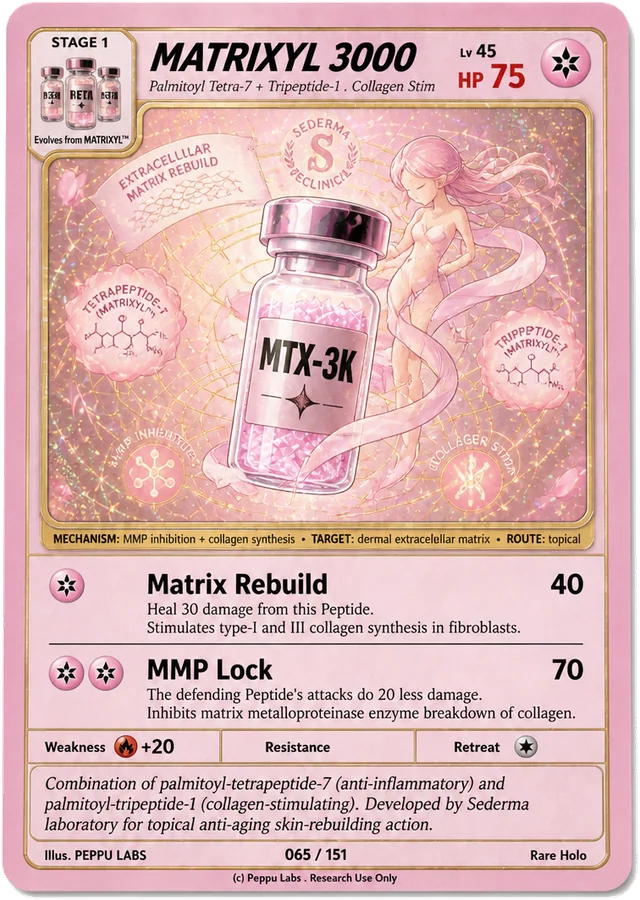
NO. 043 · BASIC · Lv. 60 · HP 90
MATRIXYL-3000
Matrikine Peptide Blend · Collagen Inducer
ALIASES
Matrixyl-3000, palmitoyl tripeptide-1, palmitoyl tetrapeptide-7, pal-GHK, pal-GQPR
CLASS
Synthetic peptide blend · matrikine-mimic collagen inducer (cosmetic)
FORMULA
C38H72N6O6 (pal-GHK) + C36H68N8O7 (pal-GQPR)
SEQUENCE
Palmitoyl-Gly-His-Lys (pal-GHK) + Palmitoyl-Gly-Gln-Pro-Arg (pal-GQPR)
HALF-LIFE
n/a · topical · no systemic exposure
ROUTES
Topical (cosmetic)
MECHANISM OF ACTION
Two-peptide blend: palmitoyl tripeptide-1 (pal-GHK) and palmitoyl tetrapeptide-7 (pal-GQPR). Both are matrikine peptides (extracellular-matrix-derived signaling fragments) that drive fibroblast collagen synthesis, elastin synthesis, and glycosaminoglycan production. Topical-cosmetic application.
EVIDENCE GRADES
Sederma in-vitro fibroblast data describes upregulation of collagen I, IV, VII and fibronectin.
Robinson 2005 reported wrinkle improvement with palmitoyl pentapeptide topical formulation.
Multiple small cosmetic trials. Limited large-scale RCT evidence.
MECHANISM CATEGORIES
RESEARCH CONDITIONS
SAFETY
Side effects
- Topical · rare mild irritation
- No systemic absorption documented
Known interactions
- No documented topical-systemic drug interactions
Contraindications
- Hypersensitivity to peptide ingredients
REGULATORY STATUS
FDA · Cosmetic ingredient · not a drug. No FDA pharmaceutical approval required for topical cosmetic use.
WADA · Not listed on the WADA Prohibited List (cosmetic ingredient, no systemic exposure).
STORAGE
Lyophilized · Room temperature, light-protected
Reconstituted · n/a · supplied in cream/serum vehicle
PEER-REVIEWED EVIDENCE
- Lintner K, Peschard O. Biologically active peptides: from a laboratory bench curiosity to a functional skin care product. Int J Cosmet Sci 2000. link →
- Robinson LR, Fitzgerald NC, Doughty DG, Dawes NC, Berge CA, Bissett DL. Topical palmitoyl pentapeptide provides improvement in photoaged human facial skin. Int J Cosmet Sci 2005. link →
FAQ · 8 QUESTIONS
▶ What is Matrixyl-3000?
Matrixyl-3000 is a two-peptide cosmetic blend developed by Sederma. The components are palmitoyl tripeptide-1 (pal-GHK) and palmitoyl tetrapeptide-7 (pal-GQPR), both matrikine peptides (extracellular-matrix-derived signaling fragments). The blend drives fibroblast collagen and glycosaminoglycan synthesis.
▶ Matrixyl-3000 vs Argireline · what's the difference?
Different mechanisms targeting different wrinkle types. Argireline blocks SNARE-complex assembly at the neuromuscular junction, reducing dynamic expression-line wrinkles. Matrixyl-3000 stimulates dermal collagen and GAG synthesis, addressing static wrinkles from extracellular matrix loss. The two are complementary; many cosmetic formulations combine them.
▶ Matrixyl-3000 vs GHK-Cu · which is better?
Both target collagen synthesis but through different mechanisms. GHK-Cu (Gly-His-Lys + Cu²⁺) is the original copper-peptide first identified in the 1970s with documented collagen and elastin synthesis induction. Matrixyl-3000 uses two palmitoylated matrikine peptides for similar but distinct signaling. Both have evidence for wrinkle reduction; GHK-Cu has the longer evidence base.
▶ How does Matrixyl-3000 work?
The matrikine peptides mimic small fragments released during extracellular matrix turnover. These fragments signal to fibroblasts to upregulate new collagen (I, IV, VII), elastin, and glycosaminoglycan synthesis · the same response a fibroblast produces during normal wound healing. The palmitoyl moiety enables transdermal penetration.
▶ Is Matrixyl-3000 FDA-approved?
Matrixyl-3000 is a cosmetic ingredient, not a drug. The FDA does not pre-approve cosmetic ingredients in the same way as drugs. Topical cosmetic use is widespread under existing FDA cosmetic-ingredient regulations.
▶ What concentration is effective?
Cosmetic formulations typically use 3-8% Matrixyl-3000. Robinson 2005 and Sederma supplier data describe measurable collagen-synthesis upregulation at these concentrations applied twice daily for 8-12 weeks.
▶ How long does Matrixyl-3000 take to show results?
Collagen synthesis is a slow process. Published trials report measurable improvements at 8-12 weeks of twice-daily topical application. Effects are dose- and duration-dependent.
▶ Is Matrixyl-3000 safe?
Topical Matrixyl-3000 has no documented systemic absorption at cosmetic concentrations. The peptides are too large for significant transdermal absorption into the bloodstream. Rare mild local irritation is reported; no systemic side effects are described.
APPEARS IN STACKS
SIGNATURE MOVES
Pal-GHK + Pal-GQPR. Collagen + GAG transcription.
Collagen I, IV, VII and fibronectin upregulation. Sederma in-vitro data.
SOURCED FROM PEPPU LABS
Reference compounds documented on this page are available as research-grade material at Peppu Studio · ≥99% purity · per-batch Certificate of Analysis. For laboratory research use only. No human dose is recommended by this wiki.
▶ LAST UPDATED · 2026-05-25