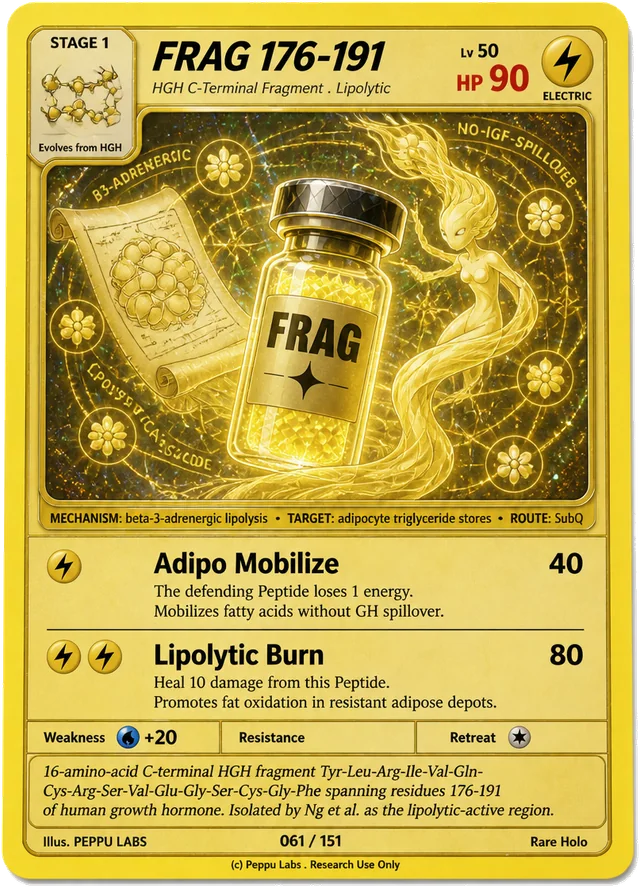
NO. 039 · STAGE 1 · Lv. 68 · HP 125
FRAG 176-191
HGH C-Terminal Fragment · Lipolytic Only
ALIASES
Frag 176-191, HGH Fragment 176-191, AOD-9604 parent fragment, lipolytic HGH C-terminus
CLASS
Synthetic peptide · HGH C-terminal lipolytic fragment
FORMULA
C78H125N23O23S2
SEQUENCE
Tyr-Leu-Arg-Ile-Val-Gln-Cys-Arg-Ser-Val-Glu-Gly-Ser-Cys-Gly-Phe (residues 176-191 of human GH)
HALF-LIFE
~30 minutes (rapid plasma clearance)
ROUTES
Subcutaneous (research)
MECHANISM OF ACTION
16-amino-acid C-terminal fragment of human growth hormone (residues 176-191), also known as AOD-9604 in its modified form. Retains the lipolytic activity of the parent HGH without IGF-1 elevation or anabolic effects. Drives beta-3-adrenergic fat oxidation in adipose tissue.
EVIDENCE GRADES
Ng et al. 2000 (PMID 10681682) demonstrated retention of HGH lipolytic activity in the 176-191 fragment without IGF-1 elevation.
Stier et al. 2013 reported Phase 2 safety/tolerability of the AOD9604 modified form in obesity.
No completed long-term Phase 3 trials for either the raw fragment or the AOD9604 modified form.
MECHANISM CATEGORIES
RESEARCH CONDITIONS
SAFETY
Side effects
- Injection-site reactions
- Generally well-tolerated in published Phase 1/2 data
- No IGF-1 elevation (key distinction from rhGH or GH-axis peptides)
Known interactions
- No major drug-drug interactions documented in published data
Contraindications
- Pregnancy/lactation (unstudied)
- Hypersensitivity
REGULATORY STATUS
FDA · Not FDA-approved. Research-use only.
WADA · Not currently listed on the WADA Prohibited List (2026). Status reviewable annually.
STORAGE
Lyophilized · 2-8 °C, 24 months
Reconstituted · 2-8 °C, 28 days
PEER-REVIEWED EVIDENCE
- Ng FM, Sun J, Sharma L, et al.. Metabolic studies of a synthetic lipolytic domain (AOD9604) of human growth hormone. Horm Res 2000. PMID 10681682. link →
- Stier H, Vos E, Kenley D. Safety and tolerability of the hexadecapeptide AOD9604 in humans. J Endocrinol Invest 2013. link →
FAQ · 8 QUESTIONS
▶ What is Frag 176-191?
Frag 176-191 is the 16-amino-acid C-terminal fragment of human growth hormone (residues 176-191). The fragment retains the lipolytic activity of the parent HGH (fat oxidation) without IGF-1 elevation or anabolic effects.
▶ Frag 176-191 vs AOD-9604 · what's the difference?
Frag 176-191 is the raw native sequence of HGH residues 176-191. AOD-9604 is the same fragment with an N-terminal tyrosine modification developed by Metabolic Pharmaceuticals to stabilize the molecule for clinical development. Same lipolytic core mechanism; AOD9604 is the formulation that entered Phase 2 obesity trials.
▶ Frag 176-191 vs HGH · which is safer?
Different molecules with different outcomes. HGH (full sequence) elevates IGF-1 and produces both lipolysis and systemic anabolism. Frag 176-191 retains only the lipolytic arm with no IGF-1 elevation, eliminating the major class-level side-effect concerns (gigantism, insulin resistance, certain tumor risk signals). Frag 176-191 has a much narrower mechanism but a safer profile in published data.
▶ How does Frag 176-191 work?
The C-terminal fragment retains the beta-3-adrenergic-receptor-mediated lipolytic signaling of the parent HGH while losing the IGF-1-axis activation (which requires the N-terminal portion of HGH for receptor binding). The result is fat oxidation without anabolic effects.
▶ Is Frag 176-191 FDA-approved?
No. Research-use only. The modified form (AOD-9604) was pursued by Metabolic Pharmaceuticals through Phase 2 obesity trials but did not progress to full approval.
▶ Is Frag 176-191 WADA-prohibited?
Frag 176-191 is not currently listed on the WADA Prohibited List as of 2026. The full HGH sequence is prohibited under Section S2; the lipolytic fragment is technically distinct due to the lack of IGF-1 elevation. Status reviewable annually.
▶ What is the half-life of Frag 176-191?
Approximately 30 minutes plasma half-life. Daily subcutaneous administration is the standard research protocol.
▶ Can Frag 176-191 be stacked with GLP-3?
Different mechanisms. GLP-3 drives central appetite suppression via GLP-1R; Frag 176-191 drives peripheral lipolysis via beta-3-adrenergic signaling. The pathways are non-overlapping and theoretically complementary. No published combination data exists in human research.
SIGNATURE MOVES
Beta-3-adrenergic fat oxidation. No IGF-1 elevation.
Pure lipolytic activity. Anti-obesity research compound.
SOURCED FROM PEPPU LABS
Reference compounds documented on this page are available as research-grade material at Peppu Studio · ≥99% purity · per-batch Certificate of Analysis. For laboratory research use only. No human dose is recommended by this wiki.
▶ LAST UPDATED · 2026-05-25