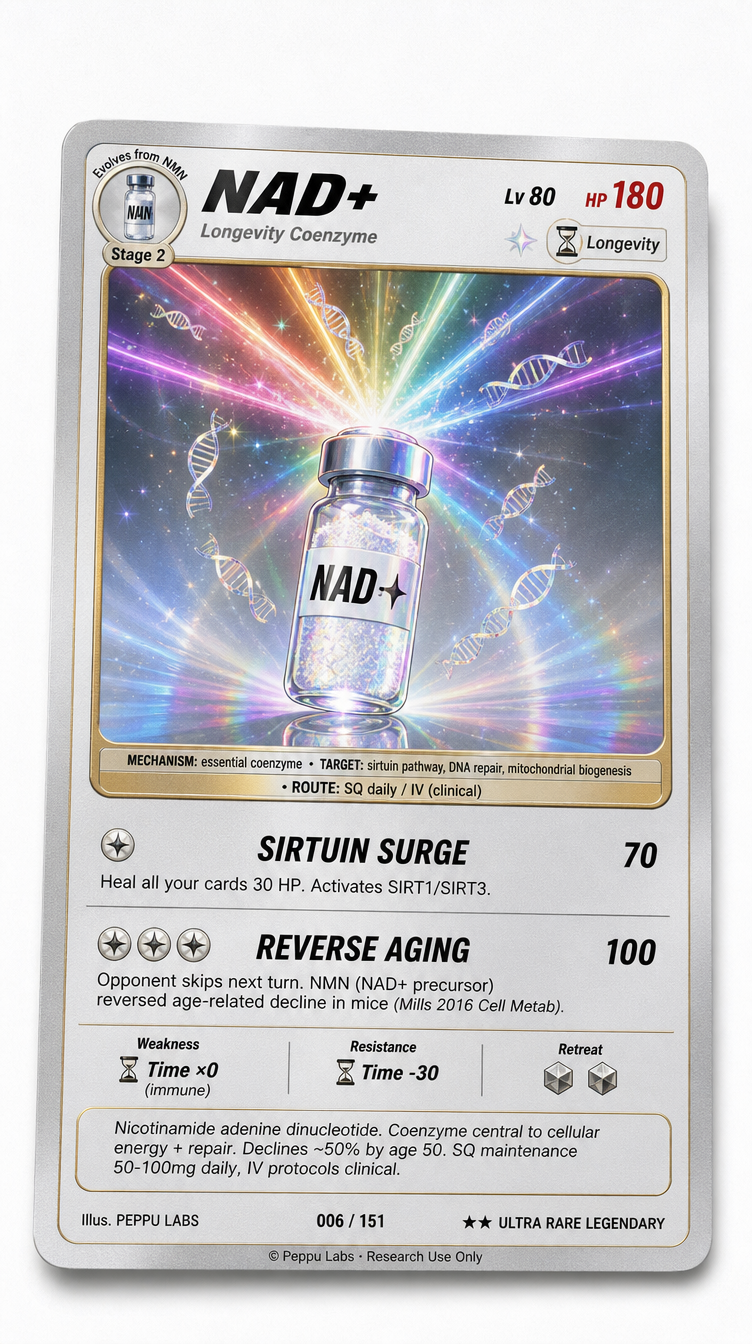
NO. 006 · STAGE 1 · Lv. 80 · HP 180
NAD+
Longevity Coenzyme
ALIASES
NAD+, NAD, Nicotinamide adenine dinucleotide, Coenzyme I
CLASS
Endogenous redox coenzyme (not a peptide)
FORMULA
C21H27N7O14P2
HALF-LIFE
Short (minutes) in plasma; intracellular pools cycled continuously
ROUTES
Subcutaneous (research) · Intravenous (research) · Oral precursors (NR, NMN) widely used
MECHANISM OF ACTION
Endogenous redox coenzyme. Substrate of sirtuins, PARPs, and CD38. Drives cellular bioenergetics through glycolysis, the TCA cycle, and oxidative phosphorylation.
EVIDENCE GRADES
Sirtuins are NAD+-dependent enzymes; sirtuin activity scales with cellular NAD+ status. Established biochemistry, decades of literature.
NR and NMN precursor trials reliably raise blood NAD+ levels. Yoshino, Imai, Baur review (PMID 29249689).
Translation of NAD+ precursor supplementation to functional endpoints (cognition, energy, metabolic markers) shows mixed results in trials. Effect sizes modest.
Direct administration of full NAD+ at the cell-membrane scale is debated; most translational interest centers on precursors that cross the plasma membrane more efficiently.
MECHANISM CATEGORIES
RESEARCH CONDITIONS
SAFETY
Side effects
- Injection-site flushing (subcutaneous)
- Nausea / chest pressure (IV, dose-dependent)
- Headache reported in IV protocols
Drug interactions
- Methyl-donor depletion theoretical with chronic high-dose precursor use
Contraindications
- Active malignancy (theoretical, due to NAD+-PARP role in cancer-cell DNA repair)
- Pregnancy/lactation (unstudied)
REGULATORY STATUS
FDA · Not FDA-approved as a drug. NAD+ precursors NR and NMN have been subject to FDA enforcement actions in 2022–2024 regarding their classification as dietary supplements vs investigational drugs. Exogenous NAD+ salt remains a chemistry reagent under standard laboratory-use framing.
WADA · Not currently listed on the WADA Prohibited List (2026).
STORAGE
Lyophilized · 2–8 °C protected from light, 12+ months
Reconstituted · 2–8 °C protected from light, aliquot-freeze beyond 7 days
PEER-REVIEWED EVIDENCE
- Yoshino J, Baur JA, Imai S. NAD+ Intermediates: The Biology and Therapeutic Potential of NMN and NR. Cell Metab 2018. PMID 29249689. link →
- Imai S, Guarente L. NAD+ and sirtuins in aging and disease. Trends Cell Biol 2014. PMID 24786309. link →
- Johnson S, Imai S. NAD+ biosynthesis, aging, and disease. F1000Res 2018. PMID 29744033. link →
FAQ · 11 QUESTIONS
▶ What is NAD+?
NAD+ is nicotinamide adenine dinucleotide in its oxidized form. It is an endogenous coenzyme found in every living cell, transferring electrons in glycolysis, the citric-acid cycle, and oxidative phosphorylation, and serving as obligate substrate of sirtuins, PARPs, and CD38.
▶ Is NAD+ a peptide?
No. NAD+ is a dinucleotide coenzyme — a small organic molecule consisting of two nucleotides (nicotinamide-ribose-phosphate and adenosine-monophosphate) joined by a pyrophosphate bridge. It is included in the PEPPUDEX as a longevity-research reference compound.
▶ NAD+ vs NR vs NMN — which is best?
NR (nicotinamide riboside) and NMN (nicotinamide mononucleotide) are NAD+ precursors that cross the plasma membrane more efficiently than full NAD+. Most clinical research uses precursors; direct NAD+ administration is debated. The precursors are most relevant for oral supplementation.
▶ Why does NAD+ decline with age?
CD38 ectoenzyme activity increases with age, hydrolyzing NAD+ on cell surfaces. Increased oxidative stress and PARP activation also consume NAD+. The net result is a documented decline in cellular NAD+ across mammalian tissues with aging (Imai & Guarente, Trends Cell Biol 2014; PMID 24786309).
▶ Is NAD+ FDA-approved?
No. NAD+ is not FDA-approved as a drug. The NAD+ precursors NR and NMN have been the subject of FDA enforcement actions regarding their classification as dietary supplements vs investigational drugs. Exogenous NAD+ salt is sold as a chemistry reagent for laboratory use.
▶ What does NAD+ do biochemically?
Three distinct roles: (1) electron transfer in dehydrogenase reactions, generating NADH for the electron-transport chain; (2) obligate substrate of class-III lysine deacylases (SIRT1–SIRT7); (3) substrate of poly-ADP-ribose polymerases (PARPs) and CD38 ectoenzymes.
▶ What's the half-life of injected NAD+?
Short — on the order of minutes in plasma. Intracellular pools are cycled continuously through the salvage pathway. Most research interest is therefore in raising intracellular NAD+ via precursors that cross the plasma membrane.
▶ Can NAD+ reverse aging?
There is no clinical evidence that NAD+ supplementation reverses aging. Precursor trials reliably raise blood NAD+ but show modest and mixed effects on functional aging endpoints (cognition, energy, metabolic markers). The biology is real; the translation is incomplete.
▶ Is NAD+ banned in sports?
Not currently listed on the WADA Prohibited List as of 2026.
▶ How is NAD+ stored?
Lyophilized NAD+ is stable at 2–8 °C protected from light for 12+ months. Reconstituted solution should be stored at 2–8 °C protected from light and aliquot-frozen for storage beyond 7 days. Avoid repeat freeze-thaw.
▶ Why is NAD+ light-sensitive?
The nicotinamide moiety undergoes photochemical decomposition under UV exposure, producing inactive degradation products. Amber-glass vials or foil-wrapped clear vials are standard practice.
APPEARS IN STACKS
SIGNATURE MOVES
Heal all your cards 30 HP. Activates SIRT1/SIRT3.
Opponent skips next turn.
SOURCED FROM PEPPU LABS
Reference compounds documented on this page are available as research-grade material at Peppu Studio · ≥99% purity · per-batch Certificate of Analysis. For laboratory research use only. No human dose is recommended by this wiki.
▶ LAST UPDATED · 2026-05-19