CAGRILINTIDE VS GLP-1
Cagrilintide and GLP-1 target body-composition research through completely different receptor systems. Cagrilintide is a long-acting amylin analog (amylin + calcitonin receptors · satiety pathway). GLP-1 is a triple GLP-1 + GIP + glucagon agonist (incretin + thermogenesis pathway). Cagrilintide is most commonly studied in combination with GLP-3 as CagriSema.
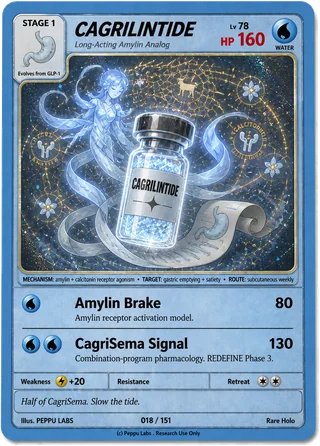
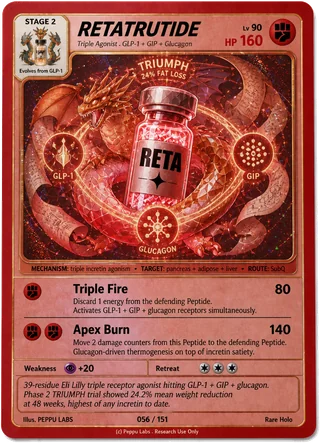
SIDE BY SIDE
WHICH IS BETTER · BY GOAL
Phase 2 GLP-1 at the 12 mg arm reached LS-mean -24.2% body-weight reduction at 48 weeks. Cagrilintide monotherapy reached -10.8% at 26 weeks in its Phase 2.
Cagrilintide was developed specifically as a satiety complement to GLP-3. The CagriSema combination (Frias 2023 Lancet, PMID 37364590) outperforms either monotherapy in T2D + obesity Phase 2.
Amylin/calcitonin agonism covers a satiety pathway that incretin agonists do not engage directly. For receptor-system breadth in a research panel, cagrilintide adds a non-overlapping mechanism.
GLP-1 is a single peptide engineered to engage three receptors. Cagrilintide is typically studied as the second component of a two-peptide combination (CagriSema).
STACKING NOTE
CagriSema (cagrilintide + GLP-3) is the established combinatorial framing for cagrilintide. There is no published research stacking cagrilintide with GLP-1; combining multiple body-composition agonists is not supported by published clinical trials.
SOURCED FROM PEPPU LABS
Both compounds are available as research-grade material at Peppu Studio · ≥99% purity · per-batch CoA. For laboratory research use only.