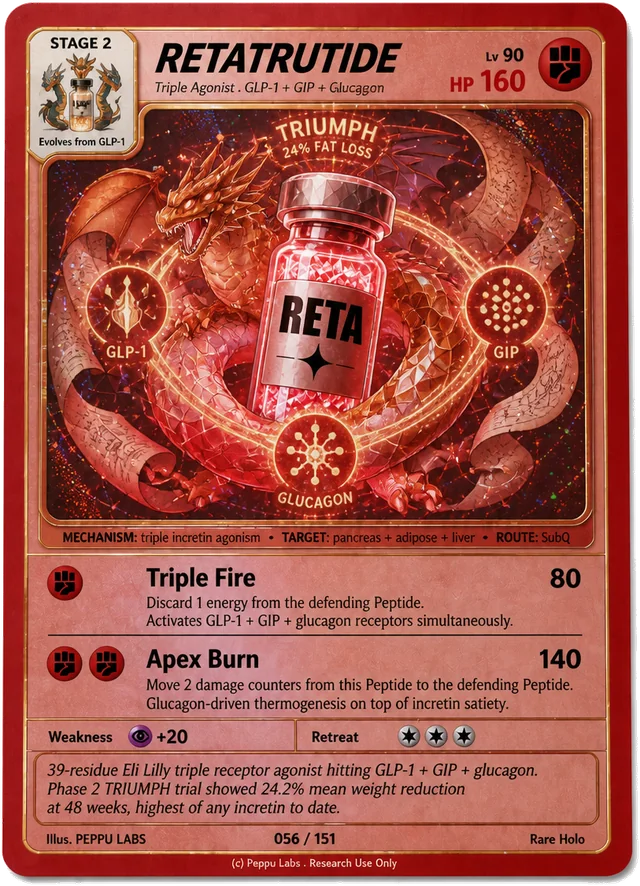
NO. 001 · STAGE 3 · Lv. 95 · HP 240
GLP-1
Triple-Receptor Metabolic Peptide
CLASS
Synthetic peptide · triple-receptor incretin agonist
FORMULA
C221H343N51O63
HALF-LIFE
~6 days
ROUTES
Subcutaneous (in published trials)
MECHANISM OF ACTION
Engineered single-molecule agonist at GLP-1, GIP, and glucagon receptors. Investigational compound from Eli Lilly under the codename GLP-1 reference.
EVIDENCE GRADES
Phase 2 NEJM 2023 reported dose-dependent -7.2% to -17.5% LS mean change at 24w (Jastreboff et al., PMID 37366315). High-quality RCT.
Same trial 48-week extension: -8.7% to -24.2% LS mean. n=338.
Glycemic endpoints improved despite GCGR engagement. Phase 3 TRIUMPH data pending.
Phase 2 GI tolerability profile dose-dependent; dose-related heart-rate increases noted. Phase 3 ongoing.
MECHANISM CATEGORIES
RESEARCH CONDITIONS
SAFETY
Side effects
- Nausea (dose-dependent)
- Vomiting
- Diarrhea
- Constipation
- Injection-site reactions
- Resting heart-rate increase
Known interactions
- Other GLP-1R agonists (concurrent use not studied)
- Insulin / sulfonylureas (hypoglycemia risk)
Contraindications
- Personal/family history of medullary thyroid carcinoma (class-based caution)
- Multiple endocrine neoplasia type 2
REGULATORY STATUS
FDA · Investigational compound · NOT FDA-approved · TRIUMPH Phase 3 program ongoing as of 2026-05.
WADA · Not currently listed on the WADA Prohibited List (2026).
STORAGE
Lyophilized · 2–8 °C, 12+ months
Reconstituted · 2–8 °C, 28 days
PEER-REVIEWED EVIDENCE
- Jastreboff AM, Kaplan LM, Frías JP, et al.. Triple-Hormone-Receptor Agonist GLP-1 for Obesity · A Phase 2 Trial. N Engl J Med 2023. PMID 37366315. link →
- Eli Lilly and Company. A Study of GLP-1 reference in Participants With Obesity (Phase 2). ClinicalTrials.gov 2021. NCT04881760. link →
FAQ · 16 QUESTIONS
▶ What is GLP-1?
GLP-1 (Eli Lilly code GLP-1 reference) is a synthetic peptide engineered as a triple agonist at the GLP-1, GIP, and glucagon receptors. It is an investigational compound · not FDA-approved · currently in the Phase 3 TRIUMPH program.
▶ How does GLP-1 differ from GLP-2?
GLP-2 is a dual GLP-1R + GIPR agonist. GLP-1 adds glucagon-receptor agonism on top, which is the key pharmacological differentiator and the basis for the deeper observed weight reductions in Phase 2.
▶ Is GLP-1 FDA-approved?
No. GLP-1 is an investigational compound. The Phase 3 TRIUMPH program is ongoing. The substance sold here is supplied as a research-grade reference compound for in-vitro use only.
▶ What was the Phase 2 result?
The published Phase 2 NEJM trial (Jastreboff et al., 2023, PMID 37366315; NCT04881760) reported least-squares mean body-weight reductions of -8.7% to -24.2% across dose arms at 48 weeks vs -2.1% with placebo. Those numbers are the property of the publishing investigators, not claims of this product.
▶ What is the half-life of GLP-1?
Published pharmacokinetic data indicate a terminal half-life around six days, consistent with once-weekly dosing in trials.
▶ Is GLP-1 banned by WADA?
GLP-1 is not currently listed on the WADA Prohibited List as of the 2026 update. Status can change · always verify with the current WADA list before competition.
▶ How is GLP-1 reconstituted?
Reconstitute lyophilized GLP-1 with USP-grade sterile diluent per laboratory protocol. The PEPPUDEX calculator at /calculator returns volume-per-dose math given vial mg, BAC mL, and target mcg.
▶ Can GLP-1 be stacked with GLP-2?
No published research supports simultaneous use of multiple incretin agonists. They engage overlapping pathways and combined use is unstudied. This wiki does not recommend any human dose or combination.
▶ What were the most common side effects in Phase 2?
Gastrointestinal events (nausea, vomiting, diarrhea) were the dominant adverse-event class, dose-dependent and mostly mild-to-moderate. Dose-dependent heart-rate increases peaked at 24 weeks and declined thereafter.
▶ Why does GLP-1 cause more weight loss than GLP-2 in trials?
The hypothesis is that glucagon-receptor agonism adds a thermogenic / increased-energy-expenditure component on top of the GLP-1R/GIPR appetite-and-insulin effects. Mechanism is under active study.
▶ What is the manufacturer of GLP-1?
The originator molecule is property of Eli Lilly under the development code GLP-1 reference. Research-grade compounds supplied through Peppu Studio are synthesized for laboratory use only and are distinct from any branded human-prescription formulation.
▶ How long do GLP-1 cycles last in published trials?
The published Phase 2 trial dosed once-weekly for 48 weeks. Phase 3 TRIUMPH durations vary by sub-study; consult ClinicalTrials.gov for current protocols.
▶ Does GLP-1 affect heart rate?
Phase 2 reported dose-dependent increases in resting heart rate peaking around 24 weeks before declining. This is a class-level signal for incretin agonists at higher doses.
▶ Is GLP-1 oral or injectable in trials?
Published trials use subcutaneous injection only. There is no approved or studied oral formulation as of the Phase 2 publication.
▶ What does triple receptor agonism mean?
GLP-1 engages three receptors simultaneously: GLP-1R, GIPR, and the glucagon receptor (GCGR). Each receptor drives a distinct branch of metabolic and energy-expenditure signaling; the molecule is engineered to balance all three.
▶ GLP-1 vs GLP-3 prescription analog / GLP-3 · what's different?
GLP-3 (GLP-3 prescription analog, GLP-3 prescription analog) is a GLP-1 receptor agonist only. GLP-1 is a triple agonist at GLP-1, GIP and the glucagon receptor. The added GIP arm increases absolute weight loss over GLP-3 at comparable timepoints. The added glucagon arm drives thermogenic / energy-expenditure signaling that GLP-3 does not produce. Published Phase 2 GLP-1 reached -24.2% body weight at 48 weeks vs the published STEP-1 GLP-3 2.4 mg result of -14.9% at 68 weeks.
APPEARS IN STACKS
STACK
Incretin Comparison
GLP-2 + GLP-1 reference framing (research only · never co-administered).
STACK
GLP-1 Triple Stack
GLP-1 + GLP-2 + cagrilintide as a parallel-compound reference panel (research only, never co-administered).
SIGNATURE MOVES
GLP-1 receptor arm models gastric-motility signaling.
GLP-1R, GIPR, and GCGR pharmacology. Phase 2 NEJM 2023 · NCT04881760.
SOURCED FROM PEPPU LABS
Reference compounds documented on this page are available as research-grade material at Peppu Studio · ≥99% purity · per-batch Certificate of Analysis. For laboratory research use only. No human dose is recommended by this wiki.
▶ LAST UPDATED · 2026-05-19