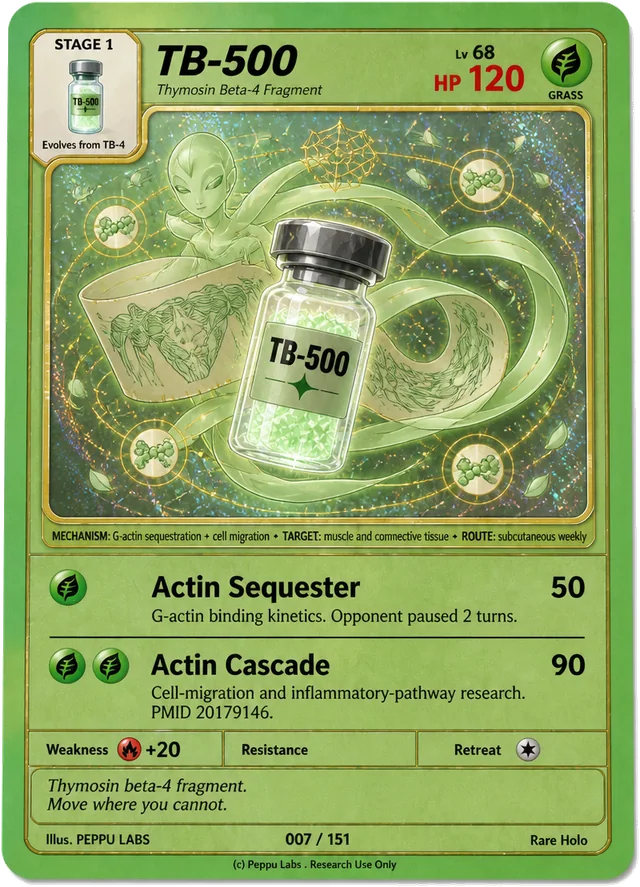
NO. 007 · STAGE 1 · Lv. 68 · HP 120
TB-500
Thymosin Beta-4 Fragment
ALIASES
TB500, Thymosin Beta-4 fragment 17-23, Ac-LKKTETQ, TB4 fragment
CLASS
Synthetic 7-amino-acid fragment of Thymosin Beta-4
FORMULA
C44H73N11O14
SEQUENCE
Ac-LKKTETQ (residues 17–23 of parent Tβ4)
HALF-LIFE
~2 hours (rat)
ROUTES
Subcutaneous · Intramuscular
MECHANISM OF ACTION
Synthetic 7-amino-acid fragment (Ac-LKKTETQ) of thymosin beta-4 retaining the actin-sequestering activity of the parent protein. Drives cell migration and tissue-remodeling pathways in animal models.
EVIDENCE GRADES
Bock-Marquette 2004 (PMID 15565145): Nature paper showed reduced infarct size and improved ejection fraction in mouse MI model.
Sosne 2001 (PMID 11311052) corneal scrape study in rats. Full-length Tβ4 has Phase 2 RegeneRx data in dry-eye.
Philp 2003 (PMID 12581423) accelerated closure in db/db diabetic and aged mice.
No human Phase 3 trials for TB-500 specifically. RegeneRx Tβ4 trials cover dry-eye and venous stasis ulcers, not tendon.
MECHANISM CATEGORIES
RESEARCH CONDITIONS
SAFETY
Side effects
- Limited human safety data
- Injection-site reactions reported anecdotally
- Theoretical fatigue or lethargy in early administration
Known interactions
- Anticoagulants (theoretical, due to angiogenic activity · unstudied)
Contraindications
- Active malignancy (theoretical, due to angiogenic + cell-migration mechanism)
- Pregnancy/lactation (unstudied)
REGULATORY STATUS
FDA · Not FDA-approved for any human use. Research-use only.
WADA · Prohibited at all times under Section S2 (Peptide Hormones, Growth Factors, Related Substances and Mimetics) · Thymosin Beta-4 and its derivatives named explicitly in the 2018 Prohibited List update.
STORAGE
Lyophilized · 4 °C 24 months, −20 °C indefinite
Reconstituted · 2–8 °C, 28 days
PEER-REVIEWED EVIDENCE
- Sosne G, Qiu P, Goldstein AL, Wheater M. Biological activities of thymosin beta4 defined by active sites in short peptide sequences. FASEB J 2010. PMID 20179146. link →
- Bock-Marquette I, Saxena A, White MD, et al.. Thymosin beta-4 activates integrin-linked kinase and promotes cardiac cell migration, survival and cardiac repair. Nature 2004. PMID 15565145. link →
- Goldstein AL, Hannappel E, Kleinman HK. Thymosin beta-4: actin-sequestering protein moonlights to repair injured tissues. Trends Mol Med 2005. PMID 16099219. link →
FAQ · 14 QUESTIONS
▶ What is TB-500?
TB-500 is a synthetic 7-amino-acid acetylated fragment (Ac-LKKTETQ) corresponding to residues 17–23 of Thymosin Beta-4, the dominant G-actin-sequestering protein in eukaryotic cells.
▶ TB-500 vs Thymosin Beta-4 · what's different?
Full Thymosin Beta-4 is a 43-amino-acid protein. TB-500 is a 7-aa active fragment that retains the actin-sequestering and cell-migration-promoting biology at a fraction of the manufacturing cost.
▶ TB-500 vs BPC-157 · which is better for healing?
Different mechanisms. BPC-157 is a 15-aa gastric-derived peptide acting through VEGF/NO/GHR pathways. TB-500 is a 7-aa Thymosin Beta-4 fragment acting through actin cytoskeleton modulation. They are commonly stacked in recovery research; no head-to-head RCT exists.
▶ Is TB-500 banned by WADA?
Yes. Thymosin Beta-4 and its derivatives, including TB-500, were named explicitly under Section S2 in the 2018 WADA Prohibited List update. Prohibited at all times (in-competition and out-of-competition).
▶ Is TB-500 FDA-approved?
No. TB-500 is not FDA-approved for any human therapeutic use. Research-grade material is supplied for laboratory use only.
▶ What is the half-life of TB-500?
Animal pharmacokinetic data report a plasma half-life around 2 hours, with longer tissue residence in cardiac and dermal sites.
▶ How does TB-500 work?
TB-500 binds monomeric G-actin, sequestering it from the F-actin polymerization pool. The cellular consequence is enhanced cell migration · particularly endothelial cells and stem-cell populations involved in tissue repair. Downstream effects include VEGF upregulation, recruitment of endogenous stem cells, anti-inflammatory NF-κB downregulation, and laminin-5 deposition in epithelial healing.
▶ Can TB-500 be stacked with BPC-157?
BPC-157 + TB-500 is the most commonly referenced recovery research stack in community protocols, on the theory of complementary mechanisms. No published clinical RCT validates the specific combination.
▶ TB-500 for cardiac repair · what's the evidence?
Bock-Marquette et al. 2004 (Nature, PMID 15565145) showed full Thymosin Beta-4 reduced infarct size and improved ejection fraction in a mouse myocardial infarction model. TB-500 fragment retains the relevant actin-cytoskeleton biology.
▶ Side effects of TB-500?
Limited human safety data. Animal toxicology shows a wide therapeutic window. Theoretical concerns include unstudied effects in active malignancy (due to angiogenic + cell-migration mechanism) and pregnancy.
▶ How is TB-500 reconstituted?
Reconstitute lyophilized TB-500 with USP-grade sterile diluent per laboratory protocol. The PEPPUDEX /calculator returns the volume-per-dose math.
▶ How long do TB-500 cycles last in animal studies?
Animal protocols vary from single-dose cardiac-MI experiments to 4–6 week dermal wound-healing studies. Community-reported research cycles cite 4–6 week loading phases at 2–5 mg/week followed by maintenance, though these are not clinical recommendations.
▶ Why is TB-500 called the 'cell migration peptide'?
Because its primary biology · binding monomeric G-actin and shifting the actin equilibrium · promotes directed cell migration. Endothelial cells migrate to angiogenic sites, stem cells migrate to injury sites, and epithelial cells migrate during wound closure.
▶ Where does TB-500 come from?
Thymosin Beta-4 was first isolated from calf thymus in 1981 by Allan Goldstein at George Washington University. TB-500 is the synthetic 7-aa active fragment, manufactured via solid-phase peptide synthesis.
APPEARS IN STACKS
STACK
Classic Recovery
The most-referenced recovery stack in community protocols.
STACK
Healing Power Trio
BPC-157 + TB-500 + MOTS-c as a regeneration-plus-bioenergetics research panel.
SIGNATURE MOVES
Status: opponent paused 2 turns. G-actin binding kinetics.
Cell-migration and inflammatory-pathway research.
SOURCED FROM PEPPU LABS
Reference compounds documented on this page are available as research-grade material at Peppu Studio · ≥99% purity · per-batch Certificate of Analysis. For laboratory research use only. No human dose is recommended by this wiki.
▶ LAST UPDATED · 2026-05-19