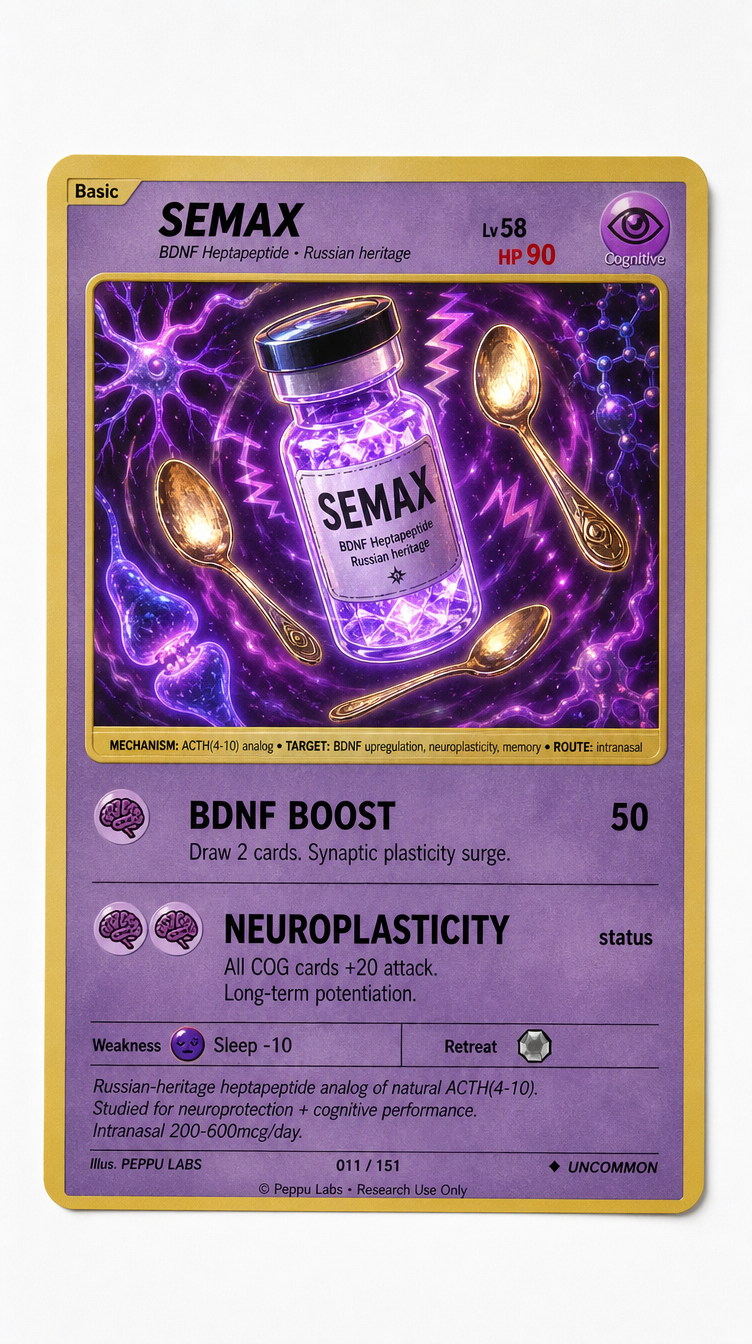
NO. 012 · BASIC · Lv. 58 · HP 90
SEMAX
ACTH(4-10) Heptapeptide · Russian-origin
ALIASES
Semax, MEHFPGP, ACTH(4-10)-PGP analog
CLASS
Synthetic heptapeptide · ACTH(4-10) analog
FORMULA
C37H51N9O10S
SEQUENCE
Met-Glu-His-Phe-Pro-Gly-Pro
HALF-LIFE
Short (minutes) plasma; intranasal CNS retention longer
ROUTES
Intranasal (registered Russian protocol) · Subcutaneous (research)
MECHANISM OF ACTION
Synthetic heptapeptide Met-Glu-His-Phe-Pro-Gly-Pro · analog of ACTH(4-10) extended with a stabilizing Pro-Gly-Pro tail. Upregulates BDNF and TrkB in rat hippocampus and basal forebrain.
EVIDENCE GRADES
Dolotov et al. 2006 (Brain Res, PMID 16996037) showed 1.4–1.6× BDNF protein elevation in rat hippocampus after single 50 µg/kg intranasal dose; matched TrkB phosphorylation.
Dolotov et al. 2006 (J Neurochem, PMID 16635254) identified specific binding sites for tritium-labeled Semax in rat basal forebrain (KD ≈ 2.4 nM).
Russian clinical literature describes small trials in stroke recovery, optic-nerve atrophy, ADHD-spectrum behavior. No FDA/EMA Phase 3 trials.
MECHANISM CATEGORIES
RESEARCH CONDITIONS
SAFETY
Side effects
- Mild nasal irritation (intranasal)
- Rare headache
- Limited Western safety data
Drug interactions
- Other serotonergic/dopaminergic medications (theoretical · unstudied combination)
Contraindications
- Pregnancy/lactation (unstudied in Western literature)
REGULATORY STATUS
FDA · Not FDA-approved. Research-use only in the United States.
WADA · Not currently listed on the WADA Prohibited List (2026).
STORAGE
Lyophilized · 4 °C 12+ months
Reconstituted · 2–8 °C, 28 days
PEER-REVIEWED EVIDENCE
- Dolotov OV, Karpenko EA, Inozemtseva LS, et al.. Semax, an analog of ACTH(4-10) with cognitive effects, regulates BDNF and trkB expression in the rat hippocampus. Brain Res 2006. PMID 16996037. link →
- Dolotov OV, Karpenko EA, Seredenina TS, et al.. Semax, an analogue of adrenocorticotropin (4-10), binds specifically and increases levels of BDNF in rat basal forebrain. J Neurochem 2006. PMID 16635254. link →
FAQ · 10 QUESTIONS
▶ What is Semax?
Semax is a synthetic heptapeptide (Met-Glu-His-Phe-Pro-Gly-Pro) analog of the ACTH(4-10) sequence developed at the Russian Academy of Sciences in the 1980s. The C-terminal Pro-Gly-Pro extension stabilizes the peptide and removes ACTH-like steroidogenic activity, preserving the neurotropic activity.
▶ Semax vs Selank — what's the difference?
Both are Russian-developed heptapeptides with the same C-terminal Pro-Gly-Pro stabilizing strategy. Selank is derived from tuftsin (immunomodulatory). Semax is derived from ACTH(4-10) (neurotropic). Semax is studied primarily for BDNF / TrkB cognitive pathways; Selank for GABAergic anxiolytic pathways.
▶ Is Semax FDA-approved?
No. Semax is research-use only in the United States. It is registered as a research and clinical neuropeptide under Russian pharmaceutical authority since 1994.
▶ How does Semax work?
Proposed mechanisms include upregulation of BDNF protein and mRNA in rat hippocampus and basal forebrain after intranasal administration, increased TrkB receptor phosphorylation (canonical signal-transduction event downstream of BDNF), and modulation of serotonin and dopamine turnover in rodent striatum and cortex.
▶ Is Semax banned in sports?
Not currently listed on the WADA Prohibited List as of 2026.
▶ How is Semax administered in Russian clinical practice?
The Russian-approved formulation is a 0.1% intranasal solution. Clinical literature describes 200–600 µg per dose, 1–3 times daily. This wiki does not recommend any human dose.
▶ What is the ACTH(4-10) sequence?
ACTH(4-10) is the 4th–10th residues of adrenocorticotropic hormone (Met-Glu-His-Phe-Arg-Trp-Gly). Semax replaces the latter residues with Pro-Gly-Pro to remove the corticotropin activity while preserving the neurotropic activity inherited from the parent fragment.
▶ Side effects of Semax?
Limited Western safety data. Russian literature describes mild nasal irritation and rare headache at standard intranasal doses.
▶ Does Semax cross the blood-brain barrier?
Intranasal Semax accesses the CNS through the olfactory bulb route, bypassing the blood-brain barrier. Specific binding sites have been identified in rat basal forebrain (Dolotov 2006, KD ≈ 2.4 nM).
▶ Is there Western peer-reviewed Semax literature?
Yes — primarily the Dolotov et al. series in Brain Res (PMID 16996037), J Neurochem (PMID 16635254), and Doklady Biol Sci (PMID 14556513). These are the most accessible Western-indexed Semax mechanism papers.
APPEARS IN STACKS
SIGNATURE MOVES
Draw 2 cards. Synaptic plasticity surge.
All COG cards +20 attack. Long-term protection.
SOURCED FROM PEPPU LABS
Reference compounds documented on this page are available as research-grade material at Peppu Studio · ≥99% purity · per-batch Certificate of Analysis. For laboratory research use only. No human dose is recommended by this wiki.
▶ LAST UPDATED · 2026-05-19