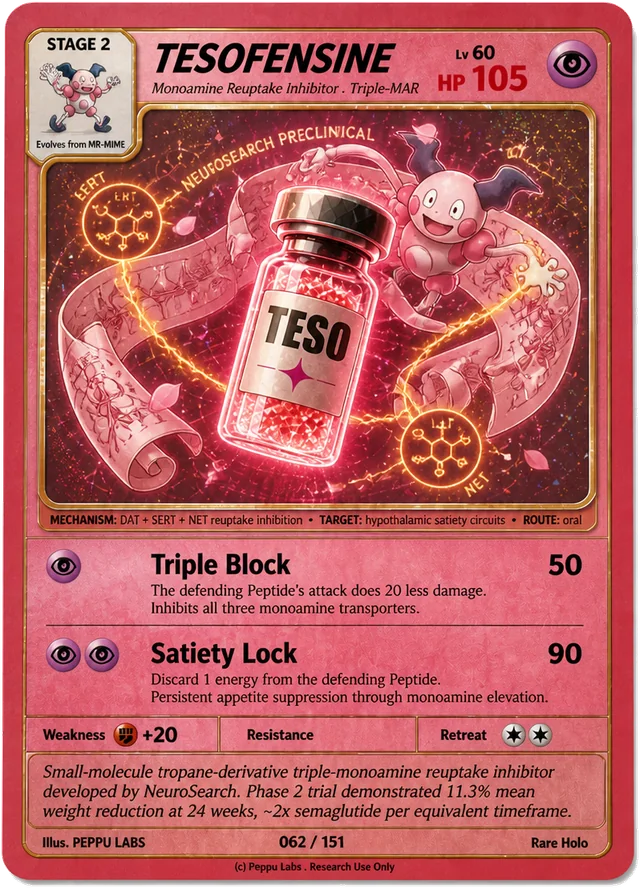
NO. 040 · STAGE 2 · Lv. 78 · HP 145
TESOFENSINE
Triple Monoamine Reuptake Inhibitor
ALIASES
Tesofensine, NS 2330, TIPO triple inhibitor, monoamine reuptake inhibitor
CLASS
Small molecule · triple monoamine reuptake inhibitor (NET / DAT / SERT)
FORMULA
C17H24ClNO
HALF-LIFE
~9 days
ROUTES
Oral (clinical trial)
MECHANISM OF ACTION
Triple monoamine reuptake inhibitor blocking norepinephrine, dopamine, and serotonin transporters (NET, DAT, SERT). Originally developed by NeuroSearch for Parkinson's and Alzheimer's disease; off-target weight-loss signal discovered in early trials. Saniona currently developing for obesity and Prader-Willi syndrome.
EVIDENCE GRADES
TIPO-1 (Astrup 2008, PMID 18950853) reported -12.8 kg LS mean weight loss at 1.0 mg vs -2.2 kg placebo at 24 weeks. n=203.
TIPO-1 reported small dose-dependent increase in heart rate and blood pressure. Manageable in further development.
Saniona TES-PWS and TES-HO Phase 3 programs ongoing in Prader-Willi and hypothalamic obesity.
MECHANISM CATEGORIES
RESEARCH CONDITIONS
SAFETY
Side effects
- Dry mouth
- Nausea
- Constipation
- Insomnia
- Dose-dependent heart rate increase
- Mild blood pressure increase
Known interactions
- MAO inhibitors (contraindicated)
- Serotonergic agents (serotonin syndrome risk)
- Stimulants (additive cardiovascular effects)
Contraindications
- Recent MAO inhibitor use
- Severe cardiovascular disease
- Pheochromocytoma
- Pregnancy/lactation
REGULATORY STATUS
FDA · Not FDA-approved. Saniona Phase 3 obesity programs ongoing.
WADA · Not currently listed on the WADA Prohibited List (2026).
STORAGE
Lyophilized · Room temperature (capsule)
Reconstituted · n/a
PEER-REVIEWED EVIDENCE
- Astrup A, Madsbad S, Breum L, Jensen TJ, Kroustrup JP, Larsen TM. Effect of tesofensine on bodyweight loss, body composition, and quality of life in obese patients: a randomised, double-blind, placebo-controlled trial. Lancet 2008. PMID 18950853. link →
- Bello NT, Zahner MR. Tesofensine: A novel weight-loss agent for obesity treatment. Drug Discov Today Ther Strateg 2009. link →
FAQ · 8 QUESTIONS
▶ What is tesofensine?
Tesofensine is a triple monoamine reuptake inhibitor that blocks the norepinephrine, dopamine, and serotonin transporters (NET, DAT, SERT). Originally developed by NeuroSearch for Parkinson's and Alzheimer's disease; the weight-loss signal was discovered as an off-target effect and is the basis for ongoing Phase 3 obesity programs.
▶ Tesofensine vs GLP-3 · which is stronger?
Different mechanisms. Tesofensine acts on central monoamine pathways; GLP-3 is a GLP-1 receptor agonist. TIPO-1 Phase 2 reported -12.8 kg at 24 weeks with tesofensine 1.0 mg, comparable to STEP-1 GLP-3 2.4 mg results at similar timepoints. Direct head-to-head not available.
▶ Is tesofensine FDA-approved?
No. Saniona is conducting Phase 3 programs in Prader-Willi syndrome (TES-PWS) and hypothalamic obesity (TES-HO). FDA approval is pending Phase 3 readout.
▶ What is the half-life of tesofensine?
Approximately 9 days. Long half-life enables once-daily dosing with steady-state plasma levels after 4-5 weeks of treatment.
▶ How does tesofensine cause weight loss?
Central monoamine reuptake inhibition increases synaptic norepinephrine, dopamine, and serotonin in hypothalamic appetite-regulating circuits. The combined effect suppresses appetite and increases energy expenditure. Different mechanism from incretin or melanocortin-targeting compounds.
▶ Is tesofensine WADA-prohibited?
Tesofensine is not currently listed on the WADA Prohibited List as of 2026. Some triple reuptake inhibitors are listed under stimulant categories; tesofensine specifically is not.
▶ What were the TIPO-1 results?
TIPO-1 (Astrup et al. 2008, PMID 18950853) Phase 2 trial reported -6.5 kg, -11.3 kg, and -12.8 kg LS mean weight loss at 0.25 mg, 0.5 mg, and 1.0 mg respectively vs -2.2 kg placebo at 24 weeks. n=203.
▶ What were the cardiovascular signals?
TIPO-1 reported dose-dependent increases in heart rate (~7 bpm at 1.0 mg) and modest blood pressure increases. The signal is manageable in further development but limits the dose ceiling and excludes patients with significant cardiovascular disease.
SIGNATURE MOVES
NET + DAT + SERT inhibition. Central appetite suppression.
TIPO-1 Phase 2 reported 12.8 kg loss at 1 mg dose over 24 weeks.
SOURCED FROM PEPPU LABS
Reference compounds documented on this page are available as research-grade material at Peppu Studio · ≥99% purity · per-batch Certificate of Analysis. For laboratory research use only. No human dose is recommended by this wiki.
▶ LAST UPDATED · 2026-05-25