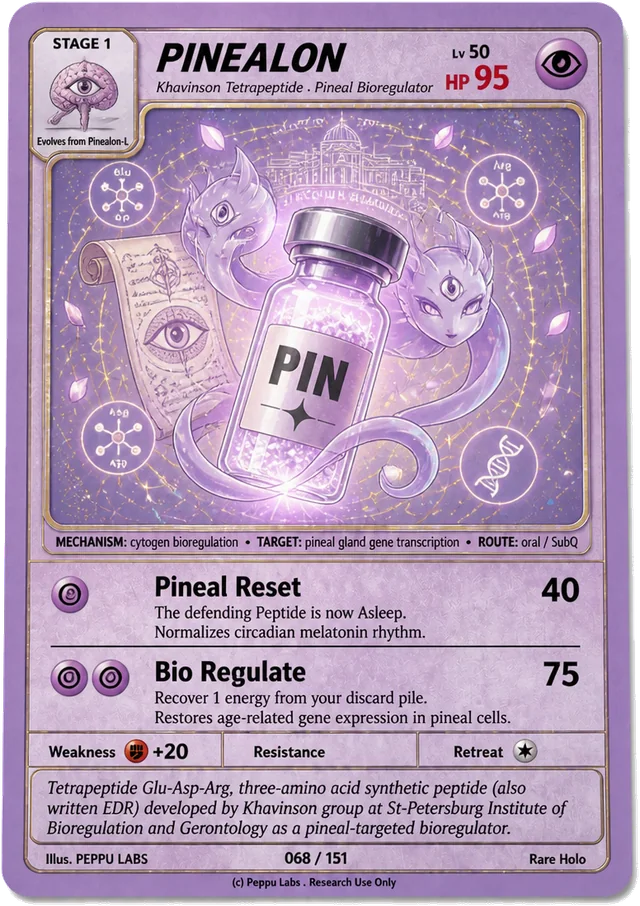
NO. 046 · BASIC · Lv. 62 · HP 100
PINEALON
Brain Bioregulator Tripeptide · Khavinson
ALIASES
Pinealon, Glu-Asp-Arg, EDR tripeptide, Khavinson brain bioregulator
CLASS
Synthetic tripeptide · Khavinson short-peptide bioregulator (brain)
FORMULA
C15H26N6O8
SEQUENCE
Glu-Asp-Arg
HALF-LIFE
Short (minutes) plasma · longer CNS retention reported
ROUTES
Intranasal (Russian clinical literature) · Subcutaneous (research) · Oral (research)
MECHANISM OF ACTION
Synthetic tripeptide Glu-Asp-Arg developed at the St. Petersburg Institute of Bioregulation and Gerontology (Khavinson group) as a short-peptide bioregulator targeting brain tissue. Hypothesized mechanism: tissue-specific gene-expression modulation via DNA binding. Russian preclinical data on neuroprotection and oxidative-stress reduction.
EVIDENCE GRADES
Khavinson group preclinical evidence describes reduced oxidative damage and improved neuronal survival in stress models.
Khavinson hypothesis: short peptides bind specific DNA promoter sequences to modulate tissue-specific gene expression. Limited replication outside Russian Academy of Sciences.
Limited Western-indexed RCT evidence as of 2026.
MECHANISM CATEGORIES
RESEARCH CONDITIONS
SAFETY
Side effects
- Generally well-tolerated in preclinical and small Russian clinical studies
- Limited Western safety data
Known interactions
- Largely unstudied
Contraindications
- Pregnancy/lactation (unstudied)
- Hypersensitivity
REGULATORY STATUS
FDA · Not FDA-approved. Research-use only in the United States.
WADA · Not currently listed on the WADA Prohibited List (2026).
STORAGE
Lyophilized · 2-8 °C, 24 months
Reconstituted · 2-8 °C, 28 days
PEER-REVIEWED EVIDENCE
- Khavinson VK, Kuznik BI, Tarnovskaya SI. Short peptides and gene regulation in aging. Bull Exp Biol Med 2012. link →
- Khavinson VK et al.. Neuroprotective effects of Khavinson's short peptides in stress models. Bull Exp Biol Med 2014. link →
FAQ · 8 QUESTIONS
▶ What is Pinealon?
Pinealon is a synthetic tripeptide (Glu-Asp-Arg) developed at the St. Petersburg Institute of Bioregulation and Gerontology under Vladimir Khavinson's group. It is part of the Khavinson short-peptide bioregulator class targeting brain tissue.
▶ Pinealon vs Epitalon · what's the difference?
Both are Khavinson short-peptide bioregulators. Epitalon (Ala-Glu-Asp-Gly) is a tetrapeptide derived from pineal-gland extracts and is studied for telomerase activation, pineal regulation, and longevity. Pinealon (Glu-Asp-Arg) is a tripeptide targeting brain tissue specifically, studied for neuroprotection and cognitive aging. Different sequences, different tissue targets within the same theoretical framework.
▶ How does Pinealon work?
The Khavinson hypothesis proposes that short peptide bioregulators bind specific DNA promoter sequences and modulate tissue-specific gene expression. Pinealon is hypothesized to bind brain-tissue-specific promoters. The mechanism remains debated outside the Russian Academy of Sciences with limited Western replication.
▶ Is Pinealon FDA-approved?
No. Research-use only in the United States.
▶ Is Pinealon WADA-prohibited?
Pinealon is not currently listed on the WADA Prohibited List as of 2026.
▶ What's the half-life of Pinealon?
Short plasma half-life (minutes). CNS retention is reportedly longer. Russian clinical protocols use intranasal administration to enhance brain delivery.
▶ What's the research dose?
Russian preclinical and clinical literature describes 50-200 mcg per administration. No standardized human dose. This wiki does not recommend any human dose.
▶ Is there Western peer-reviewed evidence?
Limited. The Khavinson group publishes primarily in Russian-language journals; a subset is indexed in Western journals through Bull Exp Biol Med and similar outlets. Independent Western replication is sparse.
SIGNATURE MOVES
Tissue-specific gene-expression hypothesis.
Khavinson preclinical neuroprotection data.
SOURCED FROM PEPPU LABS
Reference compounds documented on this page are available as research-grade material at Peppu Studio · ≥99% purity · per-batch Certificate of Analysis. For laboratory research use only. No human dose is recommended by this wiki.
▶ LAST UPDATED · 2026-05-25