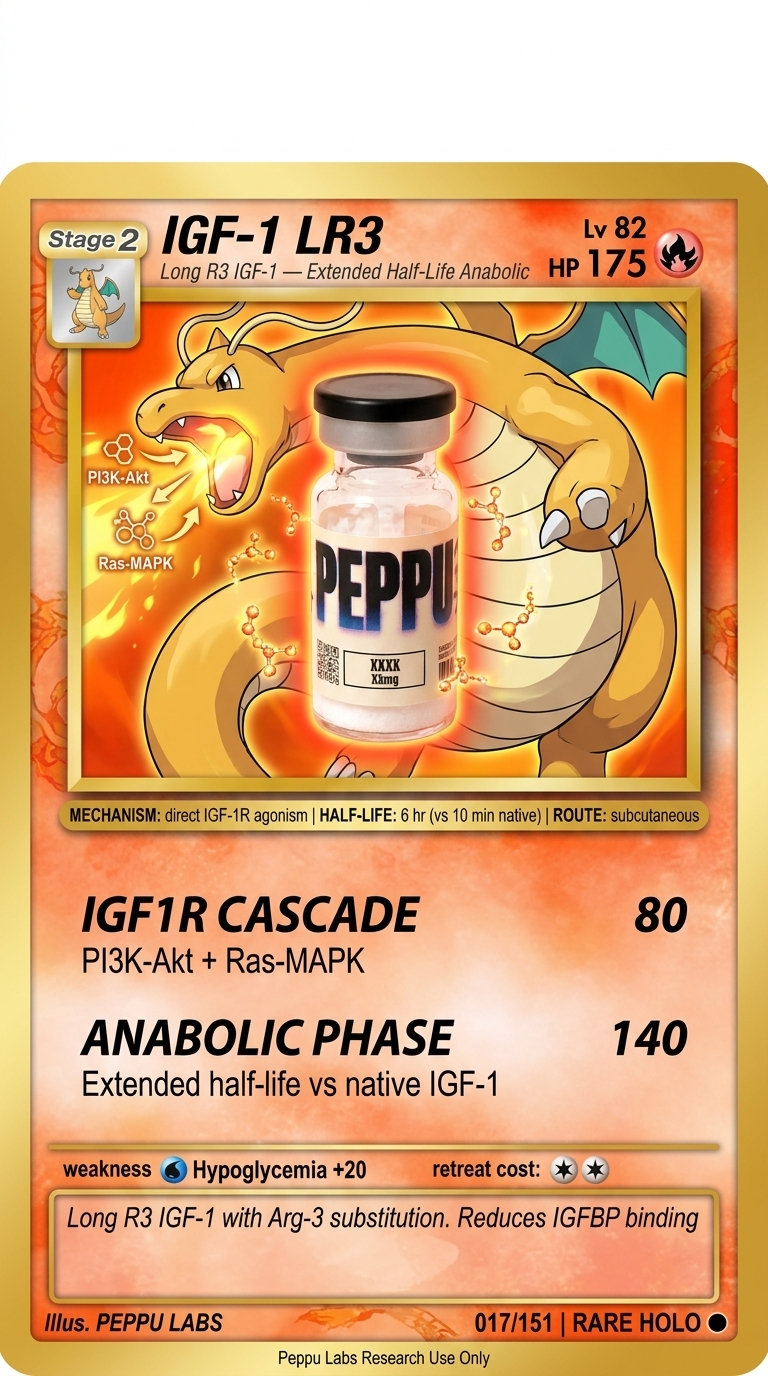
NO. 017 · STAGE 2 · Lv. 82 · HP 175
IGF-1 LR3
Long R3 IGF-1 · extended half-life anabolic research compound
ALIASES
Long R3 IGF-1, LR3 IGF-1, IGF-1LR3, IGF1 LR3
CLASS
Synthetic 83-residue insulin-like growth factor 1 analog
FORMULA
Approximately C400H625N111O115S9
HALF-LIFE
~6 hours (vs ~10 minutes native IGF-1)
ROUTES
Subcutaneous (research)
MECHANISM OF ACTION
Long R3 Insulin-like Growth Factor 1 · 83-residue synthetic analog of native IGF-1 with N-terminal 13-residue extension and Arg substitution at position 3. Engineered to reduce IGFBP binding · extends plasma half-life from ~10 min (native) to ~6 hr (LR3).
EVIDENCE GRADES
Tomas et al. 1993 reported increased protein synthesis in rat skeletal muscle with LR3-IGF-1 administration.
Walton et al. 1995 characterized 6-hour vs 10-minute half-life — the engineering goal of the LR3 modification.
No completed human Phase 3 trials. Community-reported research protocols only.
MECHANISM CATEGORIES
RESEARCH CONDITIONS
SAFETY
Side effects
- Hypoglycemia (binds insulin receptor at higher doses)
- Theoretical organ enlargement with chronic high-dose
- Theoretical concerns in active malignancy (IGF-1 axis)
Drug interactions
- Insulin / sulfonylureas (hypoglycemia risk)
- Concurrent rhGH not standard
Contraindications
- Active malignancy (IGF-1 axis growth signaling)
- Pregnancy/lactation (unstudied)
- Diabetic retinopathy (theoretical exacerbation)
REGULATORY STATUS
FDA · Not FDA-approved. Research-use only. Note: increlex (mecasermin) is FDA-approved recombinant native IGF-1 for severe primary IGF-1 deficiency — distinct molecule from LR3.
WADA · IGF-1 and analogs prohibited at all times under WADA Section S2 (Peptide Hormones, Growth Factors, Related Substances and Mimetics).
STORAGE
Lyophilized · 2–8 °C, 12+ months
Reconstituted · 2–8 °C, 14 days
PEER-REVIEWED EVIDENCE
- Tomas FM, Knowles SE, Owens PC, et al.. Long-R3-IGF-I increases protein synthesis in rat skeletal muscle. J Endocrinol 1993. link →
- Walton PE, Dunshea FR, Ballard FJ. Pharmacokinetics of LR3-IGF-I in lambs. J Endocrinol 1995. link →
FAQ · 8 QUESTIONS
▶ What is IGF-1 LR3?
IGF-1 LR3 (Long R3 Insulin-like Growth Factor 1) is an 83-residue synthetic analog of native IGF-1 with an N-terminal 13-residue extension and an arginine substitution at position 3. The modifications reduce binding to IGF-binding-proteins (IGFBPs), extending plasma half-life dramatically.
▶ Why is IGF-1 LR3 half-life longer than native IGF-1?
Native IGF-1 is rapidly cleared due to high-affinity binding by IGFBP-3 and other IGFBPs. The Arg-substitution at position 3 in LR3 significantly reduces IGFBP binding, leaving more free IGF-1 available for receptor engagement. Half-life extends from ~10 minutes (native) to ~6 hours (LR3).
▶ Is IGF-1 LR3 FDA-approved?
No. LR3 is a research-grade compound. The FDA has approved mecasermin (Increlex) — recombinant native IGF-1 — for severe primary IGF-1 deficiency. LR3 is a distinct molecule and is not approved.
▶ Is IGF-1 LR3 banned in sports?
Yes. IGF-1 and its analogs are prohibited at all times under WADA Section S2 (Peptide Hormones, Growth Factors, Related Substances and Mimetics).
▶ IGF-1 LR3 vs growth hormone — what's different?
Growth hormone (GH) is the upstream pituitary hormone. IGF-1 is the downstream effector produced primarily by the liver in response to GH. LR3-IGF-1 bypasses the GH-axis and directly engages the IGF-1 receptor — producing IGF-1-receptor effects without the broader pleiotropic GH effects.
▶ Side effects of IGF-1 LR3?
Hypoglycemia is the most acute concern — at higher doses LR3 binds the insulin receptor with sufficient affinity to lower blood glucose. Theoretical concerns with chronic high-dose use include organ enlargement and exacerbation of active malignancy via IGF-1 axis growth signaling.
▶ How is IGF-1 LR3 stored?
Lyophilized at 2–8 °C for 12+ months. Reconstituted at 2–8 °C, use within 14 days. Protein peptides this large are more sensitive to repeated freeze-thaw than smaller peptides; aliquot-freeze for long storage.
▶ Why is IGF-1 LR3 sometimes confused with IGF-1 DES?
Both are modified IGF-1 analogs. LR3 has an N-terminal extension that reduces IGFBP binding (long half-life). DES has the opposite — a tripeptide deletion at the N-terminus that also reduces IGFBP binding but with different receptor-affinity profile and shorter half-life. They are distinct compounds.
SIGNATURE MOVES
IGF-1 receptor · PI3K-Akt + Ras-MAPK signaling.
Extended half-life vs native IGF-1 (6 hr vs 10 min).
SOURCED FROM PEPPU LABS
Reference compounds documented on this page are available as research-grade material at Peppu Studio · ≥99% purity · per-batch Certificate of Analysis. For laboratory research use only. No human dose is recommended by this wiki.
▶ LAST UPDATED · 2026-05-19