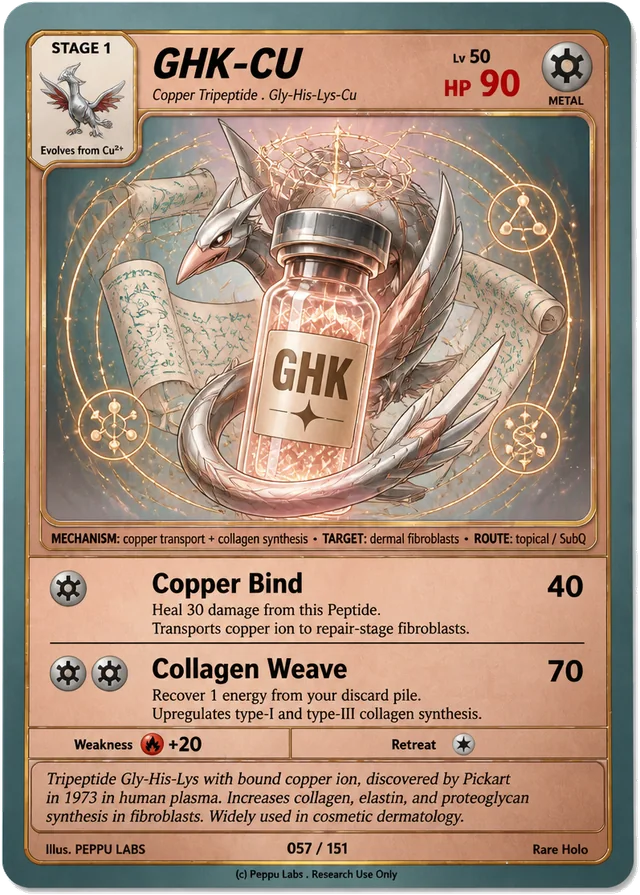
NO. 004 · BASIC · Lv. 65 · HP 100
GHK-Cu
Copper-Peptide Skin Remodeler
ALIASES
GHK, Copper Peptide, Copper Tripeptide-1, Gly-His-Lys
CLASS
Naturally occurring tripeptide-copper complex
FORMULA
C14H24CuN6O4 (Cu²⁺ complex)
SEQUENCE
Gly-His-Lys + Cu²⁺
HALF-LIFE
Short (minutes) in plasma; longer in tissue depots
ROUTES
Topical (cosmetic) · Subcutaneous (research) · Intradermal (research)
MECHANISM OF ACTION
Naturally occurring tripeptide Gly-His-Lys bound to a Cu²⁺ ion. Peer-reviewed for collagen-synthesis induction, glycosaminoglycan production, and tissue-remodeling transcriptional signaling.
EVIDENCE GRADES
Multiple peer-reviewed papers (Pickart 2008 PMID 18644225; Pickart 2012 PMID 22666519). Mechanism well-characterized in dermal fibroblasts.
Canapp 2003 dog ischemic wound model (PMID 14648531). Replicated across rodent and porcine models.
Conference-abstract level (Leyden 2002) and book-chapter compilations report improvement in fine lines, density, and clarity from 0.05–0.1% topical creams. Not full RCT publications.
Community-reported anecdotal. No completed Phase 3 hair-loss trials with GHK-Cu as primary intervention.
Pickart 2015 transcriptomic study reported modulation of multiple thousand genes in fibroblasts at the dose tested. Magnitude varies by cell type, dose, exposure window.
MECHANISM CATEGORIES
RESEARCH CONDITIONS
SAFETY
Side effects
- Localized erythema (injection site)
- Transient hyperpigmentation (topical, in some users)
- Rare contact dermatitis
Known interactions
- Vitamin C (theoretical · copper-ascorbate redox cycling)
- Retinoids (may potentiate irritation when stacked topically)
Contraindications
- Wilson's disease (copper-accumulation disorder)
- Active malignancy at the local site (theoretical, due to angiogenic activity)
REGULATORY STATUS
FDA · Topical GHK-Cu formulations are marketed as cosmetic ingredients under FDA cosmetic regulation (cosmetics generally do not require FDA premarket approval). Injectable forms are research-use only.
WADA · Not listed on the WADA Prohibited List (2026).
STORAGE
Lyophilized · 4 °C 24 months protected from light
Reconstituted · 2–8 °C, 14 days protected from light (faster degradation than non-copper peptides)
PEER-REVIEWED EVIDENCE
- Pickart L. The human tri-peptide GHK and tissue remodeling. J Biomater Sci Polym Ed 2008. PMID 18644225. link →
- Pickart L, Vasquez-Soltero JM, Margolina A. The human tripeptide GHK-Cu in prevention of oxidative stress and degenerative conditions of aging. Oxid Med Cell Longev 2012. PMID 22666519. link →
- Pickart L, Margolina A. Regenerative and protective actions of the GHK-Cu peptide in the light of the new gene data. Int J Mol Sci 2018. PMID 29986520. link →
- Canapp SO Jr, et al.. The effect of topical tripeptide-copper complex on healing of ischemic open wounds. Vet Surg 2003. PMID 14648531. link →
FAQ · 15 QUESTIONS
▶ What is GHK-Cu?
GHK-Cu is the tripeptide glycyl-L-histidyl-L-lysine bound to a copper(II) ion. It was first isolated from human plasma in 1973 by Loren Pickart and has been the subject of over 200 peer-reviewed papers on skin remodeling, wound healing, and transcriptional gene modulation.
▶ Is GHK-Cu FDA-approved?
Topical GHK-Cu is regulated as a cosmetic ingredient (no FDA premarket approval required for cosmetics). Injectable formulations are not FDA-approved for any human indication and are supplied as research-grade chemical reference compounds.
▶ GHK-Cu for skin · does it work?
Topical evidence for skin improvement is strong at the mechanism level (collagen, elastin, GAG synthesis upregulation in fibroblasts) and moderate at the human cosmetic-trial level (Leyden 2002 conference abstract; Finkley 2005 book chapter). Most published topical work uses 0.01–0.1% formulations.
▶ GHK-Cu for hair loss · does it work?
Mechanism-level data show GHK-Cu enlarges hair follicles and prolongs the anagen phase in rodent models. Human hair-loss clinical evidence is anecdotal; no completed Phase 3 trials with GHK-Cu as the primary intervention.
▶ How is GHK-Cu different from free GHK?
Free GHK is the uncomplexed tripeptide. GHK-Cu is GHK bound to a Cu²⁺ ion in a 1:1 complex. The copper-bound form is the biologically active species in most in-vitro readouts and is what circulates in human plasma.
▶ Why does plasma GHK decline with age?
Pickart's reviews quote a decline from roughly 200 µg/L at age 20 to roughly 80 µg/L at age 60. This is a summary of historical published assays, not from a single prospective cohort. The decline is hypothesized to contribute to age-related tissue-repair slowdown.
▶ What is the storage shelf-life of reconstituted GHK-Cu?
14 days at 2–8 °C protected from light. Copper-peptide complexes degrade faster than non-copper peptides in solution due to redox activity. The lyophilized cake is stable for 24+ months at 4 °C.
▶ Can GHK-Cu be injected?
GHK-Cu is supplied as a research-grade injectable reference compound. Community-reported research protocols (1–2 mg, 2–3× per week subcutaneously) are not validated by published clinical trials and are not recommendations from this wiki.
▶ Is GHK-Cu banned by WADA?
GHK-Cu is not currently on the WADA Prohibited List as of the 2026 publication.
▶ What is the molecular formula of GHK-Cu?
The complex is C14H24CuN6O4 (glycyl-L-histidyl-L-lysine + one Cu²⁺ ion in a square-planar coordination).
▶ Why is GHK-Cu blue?
The Cu²⁺ ion in the GHK-Cu complex has a characteristic d-d electronic absorption in the visible spectrum, producing the iconic cobalt-blue color of reconstituted GHK-Cu and the pale-blue lyophilized cake.
▶ Can GHK-Cu be used with retinoids?
Topical co-formulation is common in cosmetic products. Co-application can potentiate skin barrier disruption and irritation in sensitive users; alternating evenings rather than simultaneous application is the common approach.
▶ How does GHK-Cu modulate gene expression?
Pickart's transcriptomic study (Vasquez-Soltero et al. 2015) reported modulation of multiple thousand genes in dermal fibroblasts at the dose tested. The 4,000-gene figure widely cited online comes from that specific in-vitro readout; magnitude varies by cell type, dose, and exposure window.
▶ GHK-Cu vs copper peptide creams · what's different?
Many over-the-counter 'copper peptide' products contain GHK-Cu or related copper-tripeptides at lower percentages. Research-grade GHK-Cu sold as lyophilized powder is the same molecule supplied at known purity for laboratory reconstitution to any desired concentration.
▶ Is GHK-Cu safe in pregnancy?
Not studied in pregnancy or lactation. Research-grade GHK-Cu is supplied for in-vitro use only; no human dose is recommended.
APPEARS IN STACKS
STACK
Skin & Matrix
Copper-peptide collagen induction plus pentadecapeptide angiogenesis.
STACK
Anti-Aging Skin Trio
GHK-Cu + Argireline + Matrixyl-3000 covering three distinct cosmetic peptide mechanisms.
SIGNATURE MOVES
Matrix-synthesis research signal.
Tissue-remodeling kinetics.
SOURCED FROM PEPPU LABS
Reference compounds documented on this page are available as research-grade material at Peppu Studio · ≥99% purity · per-batch Certificate of Analysis. For laboratory research use only. No human dose is recommended by this wiki.
▶ LAST UPDATED · 2026-05-19