GHRP-2 VS GHRP-6
Two structurally related hexapeptide ghrelin / GHS-R1a receptor agonists in the original GH-releasing peptide class. Both trigger pituitary GH release with concomitant mild cortisol and prolactin elevation. The key practical difference is appetite: GHRP-6 has the strongest appetite signal in the class via direct ghrelin-mimetic activity on the arcuate nucleus; GHRP-2 has lower appetite signal due to differential downstream signaling. Both are largely superseded by ipamorelin in modern research protocols for cleaner profile.
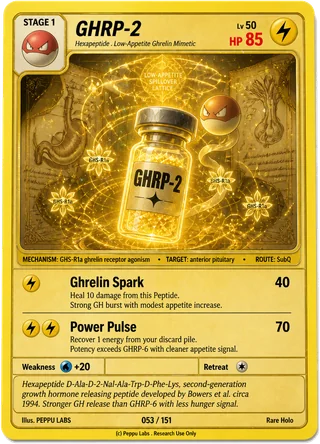
Low-Appetite Ghrelin Receptor Agonist · Pralmorelin
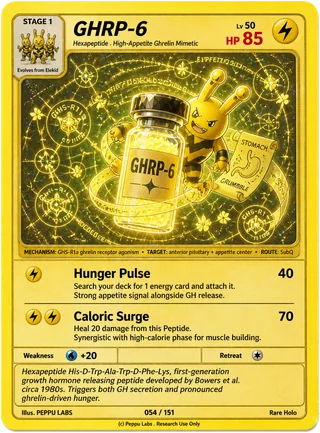
High-Appetite Ghrelin Receptor Agonist
SIDE BY SIDE
WHICH IS BETTER · BY GOAL
GHRP-2 has lower appetite signal than GHRP-6. GHRP-2 is preferred where appetite stimulation is unwanted (e.g., body-composition research).
GHRP-6 has the strongest appetite signal in the class. GHRP-6 is preferred where appetite stimulation is part of the research design (e.g., wasting-syndrome or appetite-loss research).
GHRP-2 (as pralmorelin) is approved in Japan for diagnostic GH-secretion testing. GHRP-6 has no equivalent approval.
Both produce mild cortisol and prolactin elevation. Neither is selective like ipamorelin. If clean GH release matters, ipamorelin is the better choice over either GHRP-2 or GHRP-6.
GHRP-6 is the historic prototype that established the GH-releasing peptide class (Bowers 1984).
STACKING NOTE
GHRP-2 and GHRP-6 are functional substitutes (both ghrelin-receptor agonists in the GHRP class). Choose one as the ghrelin-arm and pair with a GHRH analog (CJC-1295 No DAC or sermorelin) for dual-pathway pulse amplification. In modern research, ipamorelin (the selective GHS) is generally preferred over both GHRP-2 and GHRP-6 due to cleaner profile.
SOURCED FROM PEPPU LABS
Both compounds are available as research-grade material at Peppu Studio · ≥99% purity · per-batch CoA. For laboratory research use only.