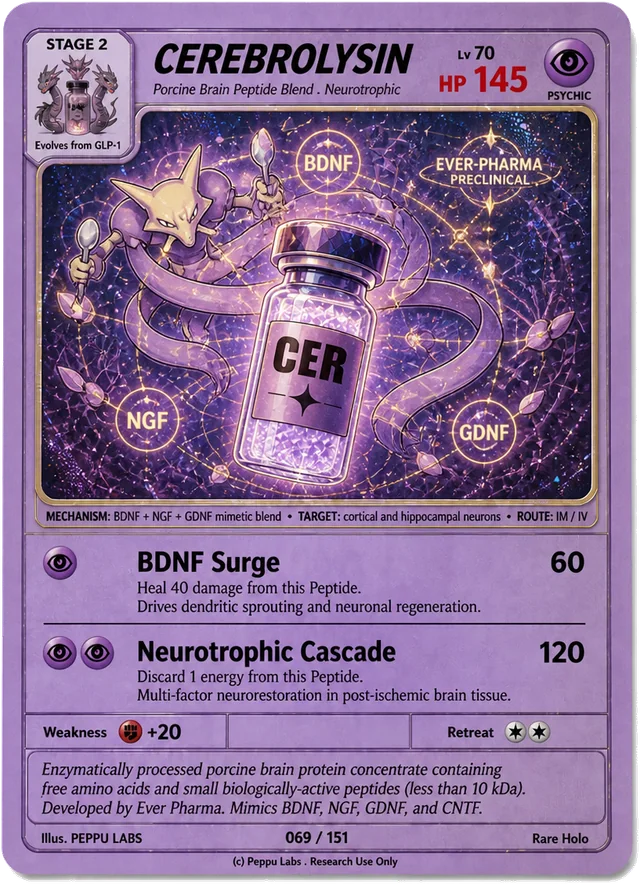
NO. 047 · STAGE 2 · Lv. 80 · HP 150
CEREBROLYSIN
Porcine Brain Peptide Preparation
ALIASES
Cerebrolysin, FPF-1070, porcine brain peptide preparation, EVER Neuro Pharma
CLASS
Porcine-brain peptide preparation · free amino acids + biologically active peptides <10 kDa
FORMULA
Complex peptide mixture · 15-25% peptides by weight, MW <10 kDa
HALF-LIFE
Variable (peptide mixture)
ROUTES
Intramuscular (clinical) · Intravenous (clinical)
MECHANISM OF ACTION
Porcine-brain-derived peptide preparation containing free amino acids and short biologically active peptides (15-25% peptides, MW <10 kDa). Acts on multiple neurotrophic pathways (BDNF, NGF, GDNF, CNTF). Marketed by EVER Neuro Pharma (Austria) in 50+ countries for stroke recovery, traumatic brain injury, and vascular dementia.
EVIDENCE GRADES
Muresanu 2016 (PMID 26786114) CARS Phase 3 reported improvement on modified Rankin Scale in moderate-severe ischemic stroke recovery.
Multiple Phase 2/3 trials in vascular dementia and mild cognitive impairment with mixed but generally favorable readouts.
European clinical literature describes use as adjunct in TBI rehabilitation.
Mixed results in Alzheimer's trials. Not FDA-approved for any neurodegenerative indication.
MECHANISM CATEGORIES
RESEARCH CONDITIONS
SAFETY
Side effects
- Injection-site reactions
- Mild headache
- Vertigo
- Rare hypersensitivity reactions
- Mild elevations in body temperature reported
Known interactions
- No major drug-drug interactions documented
Contraindications
- Severe renal impairment
- Status epilepticus (theoretical lowering of seizure threshold)
- Pregnancy/lactation (limited data)
- Hypersensitivity
REGULATORY STATUS
FDA · Not FDA-approved. Marketed by EVER Neuro Pharma in 50+ countries (Europe, Asia, Latin America) for stroke recovery, TBI, and vascular dementia. Research-use only in the United States.
WADA · Not currently listed on the WADA Prohibited List (2026).
STORAGE
Lyophilized · Room temperature in original ampoules
Reconstituted · n/a · supplied as ready-to-use solution
PEER-REVIEWED EVIDENCE
- Muresanu DF, Heiss WD, Hoemberg V, et al.. Cerebrolysin and Recovery After Stroke (CARS): a randomized, placebo-controlled, double-blind, multicenter trial. Stroke 2016. PMID 26786114. link →
- Bornstein NM, Guekht A, Vester J, Heiss WD, Gusev E, Hömberg V, Rahlfs VW, Bajenaru O, Popescu BO, Muresanu D. Safety and efficacy of Cerebrolysin in early post-stroke recovery: a meta-analysis of nine randomized clinical trials. Neurol Sci 2018. link →
FAQ · 8 QUESTIONS
▶ What is Cerebrolysin?
Cerebrolysin is a porcine-brain-derived peptide preparation containing free amino acids and short biologically active peptides (15-25% peptides by weight, all under 10 kDa). It is manufactured by EVER Neuro Pharma (Austria) and marketed in 50+ countries for stroke recovery, traumatic brain injury, and vascular dementia.
▶ How does Cerebrolysin work?
The peptide mixture acts on multiple neurotrophic pathways including BDNF (brain-derived neurotrophic factor), NGF (nerve growth factor), GDNF (glial-derived neurotrophic factor), and CNTF (ciliary neurotrophic factor). This multi-pathway action distinguishes it from single-target neurotrophic peptides like Semax.
▶ Cerebrolysin vs Semax · what's the difference?
Semax is a single synthetic heptapeptide derived from ACTH(4-10) with primary BDNF / TrkB neurotrophic mechanism. Cerebrolysin is a multi-peptide preparation acting on multiple neurotrophic pathways simultaneously. Cerebrolysin has the larger evidence base with multiple Phase 3 trials; Semax has Russian-language primary literature.
▶ Is Cerebrolysin FDA-approved?
No. Cerebrolysin is approved in Europe, Asia, and Latin America (50+ countries) but has not been approved by the FDA. Research-use only in the United States.
▶ Is Cerebrolysin WADA-prohibited?
Cerebrolysin is not currently listed on the WADA Prohibited List as of 2026.
▶ What were the CARS results?
CARS (Muresanu 2016, PMID 26786114) was a Phase 3 trial of Cerebrolysin in moderate-severe ischemic stroke recovery. The trial reported improvement on the modified Rankin Scale (mRS) at 90 days with Cerebrolysin added to standard rehabilitation. Effect size was modest but statistically significant.
▶ How is Cerebrolysin administered?
Cerebrolysin is supplied as a ready-to-use solution in ampoules and administered by intramuscular or intravenous injection. Typical clinical courses are 10-30 mL daily for 10-21 days, with cycles repeated as clinically indicated. This wiki reproduces clinical dose ranges; any human use should be under qualified medical supervision.
▶ Is Cerebrolysin safe?
Published safety data across decades of European clinical use describes generally good tolerability with mild injection-site reactions, headache, and rare hypersensitivity reactions as the most common adverse events. Severe renal impairment and status epilepticus are contraindications.
SIGNATURE MOVES
BDNF + NGF + GDNF + CNTF pathway activation.
CARS Phase 3 reported mRS improvement in moderate-severe ischemic stroke.
SOURCED FROM PEPPU LABS
Reference compounds documented on this page are available as research-grade material at Peppu Studio · ≥99% purity · per-batch Certificate of Analysis. For laboratory research use only. No human dose is recommended by this wiki.
▶ LAST UPDATED · 2026-05-25