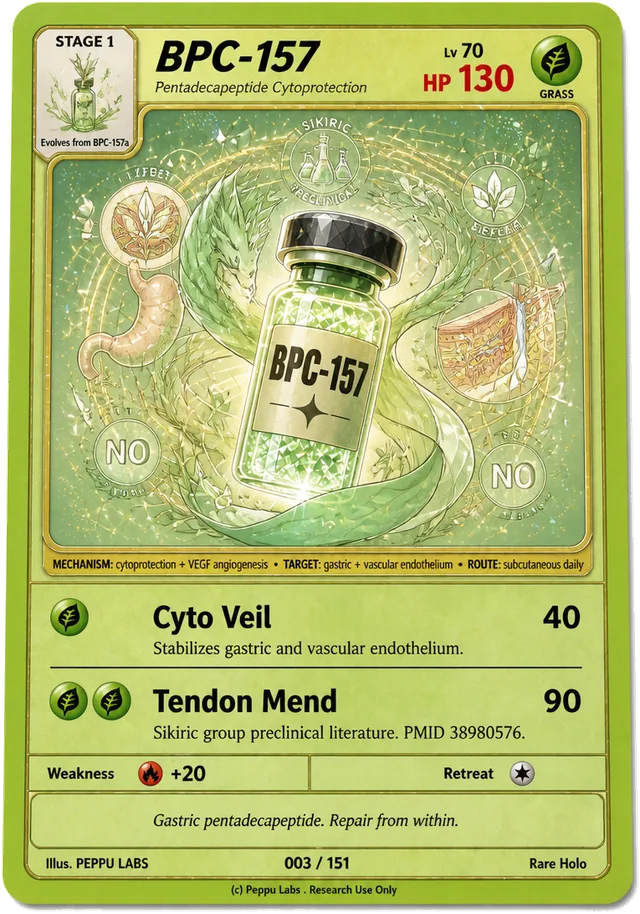
NO. 003 · STAGE 1 · Lv. 70 · HP 130
BPC-157
Pentadecapeptide Cytoprotection
ALIASES
BPC157, Body Protection Compound 157, PL 14736, pentadecapeptide
CLASS
Synthetic 15-amino-acid peptide · gastric-origin fragment
FORMULA
C62H98N16O22
SEQUENCE
Gly-Glu-Pro-Pro-Pro-Gly-Lys-Pro-Ala-Asp-Asp-Ala-Gly-Leu-Val
HALF-LIFE
~4 hours (rat, intraperitoneal)
ROUTES
Subcutaneous · Intraperitoneal · Oral (animal studies)
MECHANISM OF ACTION
Synthetic 15-amino-acid fragment of a gastric protective protein. Documented in animal-model literature for tissue remodeling, GI mucosal barrier signaling, and the cytoprotection paradigm.
EVIDENCE GRADES
Multiple rat studies (Krivic 2006 PMID 16583442; Staresinic 2006 PMID 16609979) report accelerated tendon-to-bone and quadriceps healing. Strong preclinical signal.
Sikiric group: extensive rat-model evidence of gastric and intestinal cytoprotection. Replicated across multiple sub-injury types.
Limited human clinical evidence. No Phase 3 trials registered. Anecdotal case series only.
Mechanism plausible from animal data; insufficient human RCT evidence.
MECHANISM CATEGORIES
RESEARCH CONDITIONS
SAFETY
Side effects
- Limited human safety data
- Animal toxicology shows wide therapeutic window
- Injection-site reactions reported anecdotally
Known interactions
- Anticoagulants (theoretical, due to angiogenic activity · unstudied)
Contraindications
- Active malignancy (theoretical, due to angiogenic mechanism)
- Pregnancy/lactation (unstudied)
REGULATORY STATUS
FDA · Placed on FDA Category 2 of the 503A bulks list (September 2023 update), barring compounding pharmacies from preparing it under section 503A. Not FDA-approved for any human use.
WADA · Prohibited at all times (in-competition and out-of-competition) under S0 'non-approved substances' since the 2022 Prohibited List.
STORAGE
Lyophilized · 4 °C 24 months, −20 °C indefinite
Reconstituted · 2–8 °C, 28 days
PEER-REVIEWED EVIDENCE
- Sikiric P, Sever M, Krezic I, et al.. New studies with stable gastric pentadecapeptide protecting gastrointestinal tract. Inflammopharmacology 2024. PMID 38980576. link →
- Krivic A, Anic T, Seiwerth S, Huljev D, Sikiric P. Achilles detachment in rat and stable gastric pentadecapeptide BPC 157. J Orthop Res 2006. PMID 16583442. link →
- Staresinic M, Sebecic B, Patrlj L, et al.. Effective therapy of transected quadriceps muscle in rat: Gastric pentadecapeptide BPC 157. J Orthop Res 2006. PMID 16609979. link →
- Matek D, Matek I, Japjec M, et al.. Tendon, Ligament, and Muscle Injury · Cytoprotection Review with BPC 157. Pharmaceuticals (Basel) 2026. PMID 41754849. link →
FAQ · 18 QUESTIONS
▶ What is BPC-157?
BPC-157 is a synthetic 15-amino-acid peptide derived from a partial fragment of body protection compound, a protein found in human gastric juice. It is one of the most-studied peptides in the animal-model tissue-repair literature.
▶ Is BPC-157 legal in 2026?
In the US: BPC-157 is on FDA Category 2 of the 503A bulks list (Sept 2023 update), meaning compounding pharmacies cannot prepare it. It is sold as a research-grade chemical reference compound. WADA prohibits it in all sports under S0.
▶ What is the half-life of BPC-157?
Animal studies report a plasma half-life around 4 hours after intraperitoneal administration. The peptide is also reported to remain stable in human gastric juice for over 24 hours, which is unusual and theorized to underpin oral activity in animals.
▶ Can BPC-157 be taken orally?
Animal studies show oral and drinking-water routes preserve activity, attributed to the unusual gastric-juice stability. Human oral bioavailability has not been characterized in clinical trials.
▶ BPC-157 vs TB-500 · what's different?
BPC-157 is a 15-aa gastric-derived peptide acting through VEGF/NO pathways and growth-hormone-receptor upregulation. TB-500 is a 7-aa Thymosin Beta-4 fragment that sequesters G-actin. Different mechanisms. They are commonly stacked in recovery research.
▶ Are there human trials for BPC-157?
Limited. Sikiric et al. ran early-phase ulcerative colitis trials (PL 14736 designation). No completed Phase 3 trials registered. ClinicalTrials.gov lists exploratory studies that have not enrolled at scale.
▶ Is BPC-157 FDA-approved?
No. BPC-157 is not FDA-approved for any human indication.
▶ How long do you cycle BPC-157 in animal studies?
Published animal-model protocols typically span 2–8 weeks of daily administration. Community-reported research protocols cite 8–12 week cycles, though those are not clinical recommendations.
▶ Side effects of BPC-157?
Animal toxicology shows a wide therapeutic window with no documented LD1. Human safety data are limited. Theoretical concerns include unstudied effects in active malignancy (via angiogenesis) and pregnancy.
▶ Does BPC-157 help tendons?
Animal-model evidence is substantial: Achilles detachment in rats showed accelerated tendon-to-bone healing (Krivic et al. 2006 PMID 16583442). Transected quadriceps showed accelerated functional recovery (Staresinic et al. 2006 PMID 16609979). Human translation is not yet validated by RCT.
▶ What is the mechanism of action of BPC-157?
Proposed mechanisms include upregulation of growth-hormone-receptor expression in injured tissue, VEGF-driven angiogenesis, modulation of the nitric-oxide pathway in vascular endothelium, and activation of FAK-paxillin signaling. BPC-157 does not bind a single canonical receptor; its activity appears permissive of healing processes already underway.
▶ BPC-157 vs collagen peptides · what's different?
Collagen peptides are dietary protein hydrolysates supplying amino acid building blocks. BPC-157 is a defined synthetic 15-aa sequence acting as a pharmacological signaling molecule. Completely different category and mechanism.
▶ Can BPC-157 be stacked with TB-500?
Stacking BPC-157 + TB-500 is the most common recovery research stack referenced in community protocols, on the theory of complementary mechanisms (BPC-157 angiogenesis + TB-500 actin-cytoskeleton-driven cell migration). No published RCT validates the combination.
▶ Where is BPC-157 manufactured?
Research-grade BPC-157 is synthesized via solid-phase peptide synthesis at certified peptide manufacturing facilities. Peppu Studio publishes per-batch Certificates of Analysis showing HPLC purity and identity confirmation.
▶ How is BPC-157 stored?
Lyophilized BPC-157 is stable at 4 °C for at least 24 months and indefinitely at −20 °C. Reconstituted solution should be stored at 2–8 °C and used within 28 days. Do not freeze the reconstituted solution.
▶ Why was BPC-157 placed on the FDA bulks list?
The September 2023 503A bulks-list update placed BPC-157 in Category 2, citing insufficient evidence for the FDA to determine that compounding it for routine clinical use is safe and effective. The substance remains available as a research-grade chemical reference compound.
▶ BPC-157 for gut health · what's the evidence?
Animal-model evidence is strong: rat ulcerative colitis, ileoileal anastomosis (Vuksic 2007), gastric-mucosal protection studies (Sikiric multi-paper). Human evidence is limited to early-phase ulcerative colitis trial work under the PL 14736 designation.
▶ How does BPC-157 differ from full body protection compound?
Full BPC is a larger protein found in human gastric juice. BPC-157 is a 15-amino-acid fragment of that protein (residues 134-148 of the parent sequence). The fragment retains the cytoprotective and tissue-remodeling activities of the parent.
APPEARS IN STACKS
STACK
Classic Recovery
The most-referenced recovery stack in community protocols.
STACK
Skin & Matrix
Copper-peptide collagen induction plus pentadecapeptide angiogenesis.
STACK
Healing Power Trio
BPC-157 + TB-500 + MOTS-c as a regeneration-plus-bioenergetics research panel.
SIGNATURE MOVES
Stabilizes gastric and vascular endothelium.
Sikiric group preclinical literature.
SOURCED FROM PEPPU LABS
Reference compounds documented on this page are available as research-grade material at Peppu Studio · ≥99% purity · per-batch Certificate of Analysis. For laboratory research use only. No human dose is recommended by this wiki.
▶ LAST UPDATED · 2026-05-19